
< Previous | Contents | Next >
Castle Gate, Walnut Tree Lane
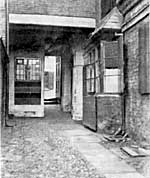
Lawrence Collins' house, Castle Gate in the 1920s.
Proceeding up Castle Gate, a little entrance, No.41, gives access to a beautiful and quiet little backwater with a most charming house built of moulded bricks and bearing high up on its wall a lozenge bearing the inscription L.CA.and the date 1664. This is a house that was built by Lawrence Collin after the cessation of the Civil War. He had been the gunner in Nottingham Castle and at the conclusion of hostilities he desired to remain in Nottingham as a tradesman, but some difficulties were made by the Corporation, which were quickly dispelled by a peremptory order from Lord Protector Cromwell and Collin was allowed to settle down and trade in peace. Well it was for the town that he was allowed to do so. He laid the foundations of the family fortune and his son Abel Collin carried the family affairs to higher planes. He took an interest in the management of Smith's Bank and eventually upon his death he directed his nephew Thomas Smith to establish the charity which is known as Collin's Alms Houses which are still doing noble and increasing work in our midst. Lawrence Collin died in 1704 at the age of 91 and was buried in St. Nicholas Church, and as his daughter Fortune married into the banking family of Smith his blood may be said to be still actuating the business enterprises of Nottingham.
The little entry is one of the most beautiful spots in the whole of Nottingham, particularly in the Autumn when the gardens at the back are a blaze of nasturtiums, and to the sympathetic eye the details of the architecture are full of interest, while the tradition still lingers that the room illuminated by the window with a drop shutter was used as headquarters by Cromwell when he visited Nottingham in 1650.
Exactly opposite this entrance are two ancient houses probably built in Stuart times, one with a pointed gable and the other with a curved gable fronting on to Castle Gate. These houses were built in the true Gothic spirit for the straight edged gable is one of the hall marks of the latest phase of Gothic architecture while the curved gable shows the influence of the buildings of the Low Countries which was beginning to make itself felt.
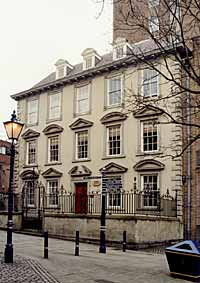
Newdigate House on Castle Gate (A Nicholson, 2001).
Next door to these two ancient houses is Newdigate House which appears to have been erected sometime about 1675 or contemporary with the Castle. It cannot be very much younger than the two houses next door to it and it is extremely instructive to watch the development from the Gothic straight gabled house to this purely classic house with all its details carefully worked out as a true Renaissance building. Particularly interesting is it to note the treatment of the dormer windows. The outer walls are encased with stucco and all the window and the door openings are heavily emphasized. A heavy cornice marks the juncture of the roof with the walls and the corners are further emphasized by the introduction of great blocks. We notice that the value of the leads as a promenade had not been discovered when this house was built. The most important inhabitant of this house was Marshal Tallard who spent many years of his captivity in it. He was defeated by Marlborough at the Battle of Blenheim in 1704 and Marlborough's despatch announcing his victory in the words "Tallard and the other generals are in my coach" is surely one of the most striking of military despatches. Marshal Tallard was a cultured gentleman and he decided to make the best of his captivity and so he settled down in Nottingham and soon found a way of living a normal life and making himself popular and useful to his erstwhile enemies, and he introduced a good deal of the courtesy of French manners to our uncouth forefathers. He taught our housewives how to make French rolls and salads. He made gardening extremely popular for he was a great gardener, and above all he introduced celery which he cultivated from the wild celery that he found growing on the banks of the Leen into England. He seems to have quite settled down in England for it is believed that he built two houses in the Market Place the twisted columns of one of which on the Long Row only disappeared in 1925. Portions of his garden attached to Newdigate House still remain behind the high brick wall fronting on to Castle Gate.
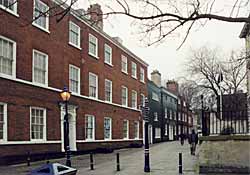
Georgian terrace opposite Newdigate House, Castle Gate (A Nicholson, 2001).
Almost opposite to Newdigate House are two or three broad shouldered 18th century houses which give very typical examples of the architecture of the times. Beyond the fact that on their rear wall facing Walnut Tree Lane there is a date stone C.LM. 1788 I can find nothing more, but they are of great beauty and dignity. A little higher up than Newdigate House on the other side of the road is the most beautiful doorway in the whole of Nottingham. It leads into a quite unimportant house, but it is an object of extreme beauty and interest. Fluted pilasters carry a heavy pediment and the doorway is crowned by a fan-light of the most delightful design.
Walnut Tree Lane is a sunken road whose rocky sides have been cut away to accommodate the erection of buildings, the original ground level being shown by Castle Terrace and St. Nicholas Churchyard. In the course of ages the name of Walnut Tree Lane seems somehow or other to have become exchanged with Fink Hill Street which is its continuation in an easterly direction. At the upper end of Walnut Tree Lane looking towards Castle Gate may be seen numerous remains of delightful Stuart buildings with their high pitched straight edged gables and even in one or two cases the ancient casements still remaining in use. In fact I know of nowhere in the town where this type of building can be better studied than just here On the western side of the street is a derelict site which is the old burial ground of the Quakers. It was much disturbed and altered in 1903 and its future seems uncertain.
Almost opposite the end of Mortimer Street will be found certain old stones used as a footing for a garden wall which I believe are further relics of the old Plantagenet Wall round the town of Nottingham, though I do not think that they are in situ.