
< Previous | Contents | Next >
Postern Street, Rutland Street and St James' Street
The site upon which the hospital and its grounds stands is not without its historical interest. In olden times there were two hillocks one on either side of the present Postern Street. These have completely disappeared, but it is believed by antiquaries that they may have been pre-historic tumuli. That at the western side where the hospital now stands was called Derry Mount and it was dug down in 1777. In the course of the excavations human remains were discovered one of which was a skull with a bullet hole in it and associated with these remains were a silver coin and a copper token which bore the legend "Thomas Cheshire at the King's Head, Fore Street, 1669, his halfpenny." Probably these were burials intruded upon the ancient tumulus and may perhaps be associated with the fighting during the Civil Wars. The other hill, on the eastern side of Postern Street was called Windmill Hill and carried a mill during Jacobean times which accounts for the old name of Windmill Passage which was applied to Postern Street until about 150 years ago.
The foundations of an ancient guard house were discovered in 1818 and still remain, I believe, beneath the modern sanitary tower of the hospital, while in 1899 when great excavations were undertaken in preparation for the erection of the Jubilee Wing of the hospital this guard house was again seen and very extensive subterranean passages were discovered which seemed to connect Standard Hill with the old ditch of the castle facing northwards. These antiquities were carefully plotted and a paper was published by Mr. James Shipman who gives us a very full account of what he saw. I must frankly confess that a study both of Mr. Shipman's paper and of his plan has left me that no very clear idea as to what the use of these passages could have been.
Postern Street was called by our grandfathers Boston Bridge. About 1260 a postern was erected by Henry III. in the defences of Nottingham Castle of such width that two horsemen carrying lances could pass through it abreast. I think that this postern probably stood somewhere near the site of the present entrance to the hospital enclosure and faced down the Ropewalk, at any rate, Postern Street originally came out about in that position and the Ropewalk formed its direct continuance without the unfortunate angles which now mar the thoroughfare in that direction. A deep ditch as we shall see presently further protected the castle in this neighbourhood and ran down Park Row and to get across this ditch a bridge would be necessary. This was called the Postern Bridge which was gradually colloquialised into Boston Bridge. A small portion of this ditch still remains as a hollow in the grounds of the hospital.
The most striking building in Postern Street is of course the old Children's Hospital, on its eastern side. This was founded in 1869 by a lady under the auspices of a Church of England Sisterhood and she was dedicated to her work in the now disused chapel of the hospital by the then Bishop of Lincoln. The wooden outer gateway of this hospital facing into Postern Street is interesting. It is enriched with 14th century moulding and quatrefoils and it is made out of four rafters from the roof of Alfreton Church. Alfreton Church was being restored about the time that the hospital was erected and it was found necessary to replace its ancient roof by a modern one. Four of the old rafters were preserved and so arranged as to form a dignified arch of entrance into the premises of the new Children's Hospital. The water tower which serves as a support for the bridge connecting this hospital with the General Hospital was erected by the Corporation. This building is no longer used as a children's hospital, but is part and parcel of the greater General Hospital.
Of Rutland Street there is little to say. It is rather a dreary neighbourhood and the only building of interest in it is an old school which was built in 1808 as a School of Industry. It has long since been abandoned and is now used as a factory. The most interesting thing about the street is its name which as we have seen reflects the association of this district with the great Rutland family.
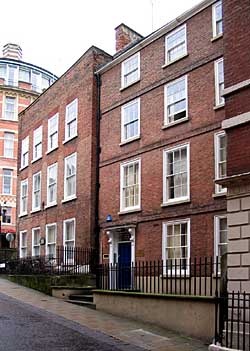
Georgian houses at the top of St James' Street. The house on the end was occupied by Lord Byron.
St. James's Street on the other hand is full both of beauty and interest. It is a thoroughfare of very great age and in 1395 we find it referred to as "Jamgate" and it was not until 1800 that it received its modern name. The last house on its north west side which is nowadays called Newstead House was the residence of Lord Byron when a boy. It was while living here that he perpetrated the well-known squib upon his bete noire, a relative living in Swine Green. This person had the misfortune to greatly offend the childish poet by reference to his lameness and probably to some of his many other childish faults. He was brought home in a state of high dudgeon and remained quiet and morose for some time. At last he burst out with the couplet:—
"I wish such a person never had been,
As the odious old woman who lives in Swine Green."
This outburst seemed to comfort him and it is curious that it has come down to our own day and is probably more frequently quoted than any other of the poet's utterances.
It was to this house that Leigh Hunt used to come to solace himself "with the singing of birds, the humming of bees and the whetting of the mower's scythe." He was an extraordinary character with considerable pretension to literary abilities. At Shelley's invitation he went out to Italy and arrived at Pisa just a week before Shelley was drowned. He had, however, contracted an acquaintance with Byron who was living in Pisa at the time, and together they attempted to found a journal called The Liberal, but it was not a success and soon became extinct. However, Hunt made shift with his literary abilities to live and although he and Byron never seemed to get on very well together, yet when they were apart they seem to have been extremely fond of each other and eventually Hunt wrote the life of Byron under the title of Lord Byron and his Contemporaries.
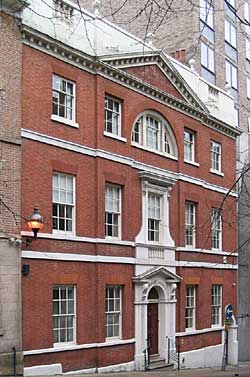
Georgian house on St James' Street (A Nicholson, 2004).
There is a great deal of delightful 18th century architecture in St. James's Street and the fan lights alone are worthy of most careful study. The Thoroton Press stands upon the vista of one of the delightful houses which line the northern side of the street and perhaps the most beautiful of all these houses is number 64. At one time in its career it was used as a hospital for the blind with a certain Mrs. Shipstone as Matron, but its chief claim to our attention is the extreme beauty of its details. Its staircase, whether for the ease of its ascent or the beauty of its enrichment, is noticeable even in a city of fine staircases such as is Nottingham, while the panelling, cornice and fireplace of the room at present used by the Medico-Chirurgical Society is worth a long journey to see.