
< Previous | Contents | Next >
The Market Place
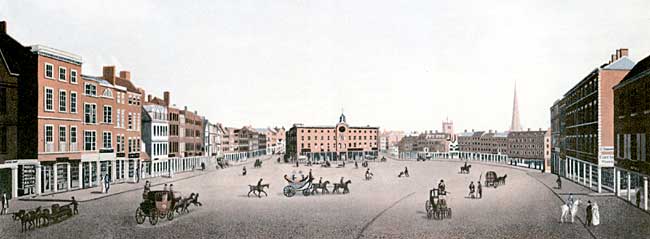
The Market Place in the early 19th century.
And now we come to the great open Market Place which is so prominent a feature of Nottingham. It is the largest open market in England and I have heard it said that it was possible to buy all domestic requirements within its borders. Its history is as interesting and diversified as the market itself and extends far back in the story of Nottingham. Its real name is the Saturday Market which differentiates it from the Weekday Market which was held as we have seen at Weekday Cross and which is a far older institution than is the ordinary market of Nottingham. The Weekday Market was the daily market of the old English borough which was held upon every day of the week except Sunday right down to the Norman Conquest and at it all the local domestic requirements would be fulfilled. But the Saturday Market when it was established was of far wider range than this. The old Weekday Market was transferred to the Great Market Place on Saturday and to this Saturday Market resorted country folk from the whole district so that it might almost be called a wholesale market.
We have seen that ancient Nottingham consisted of two towns, there was the old English borough round about where St. Mary's Church stands and there was the new French borough formed mainly by the dependents of Peveril round about where the Castle stands. The inhabitants of these two towns were in a state of what might be called armed peace, ever ready to fly at each others throats. The men of Nottingham apparently fought against Tosti at Stamford Bridge and were pretty badly mauled in securing that victory. Whether this was so or not it is believed that the contingent from Nottingham did not arrive at Senlac in time to take part in Harold's battle against William I., and consequently they were not acquainted at first hand with the strength of the Norman arm, so that when Peveril took charge of Nottingham Castle he found that he had to deal with a very truculent native populace. He quickly found that if he allowed his followers to frequent the Weekday Market in the heart of the English borough at such a distance from his main body, the English were not overawed by his display of force and innumerable quarrels and bickerings took place; and so, possibly bethinking himself of the plan adopted by the ancient Romans when they established the Forum Romanum half way between their own settlement on the Palatine and the Sabine settlement on the Capitoline Hill, he decided to establish a market place that would be mutual to both towns. A site for such a market, was ready to his hands in the great, derelict, unbuilt-upon area situated between the two towns which has come down to our own day as the Great Market Place.
When we were considering the layout of the primitive roads of Nottingham in the opening pages of these notes we got some idea as to how the Market Place came to adopt its present shape, and saw that both its position and its curious plan was determined by the ancient road system. There was an ancient manorial division running right across the site which was coincident with the trackway which ran down the Poultry and Exchange Alley to Chapel Bar, and this boundary seems to have been emphasized by a wall. This wall gave Peveril exactly what he wanted. He established a market in the whole area and granted the northern or Long Row side to the English while he retained the remainder of the site for his French followers. The two nations would be able to traffic over the wall and certain passages were made through it to facilitate this traffic. It is interesting to remember that this manorial boundary was long used as a parish boundary, but it was found to be inconvenient and so in later years the parish boundary was moved forward so as to coincide with what we now call South Parade.
Another interesting point to remember is that this market was not a several, but a joint, market and, certainly, as part of it was included in the Royal Manor, that part at any rate would not need a charter.
We first definitely hear of this market in the reign of Henry II. (1154-1189), who in a charter granted to the town of Nottingham says "moreover the men of Nottinghamshire and Derbyshire ought to go to the borough of Nottingham on Friday and Saturday with their wains and packhorses." This seems to visualise a market which would start at sunset on Friday and would not terminate until sunset on Saturday, and the reason that the Derbyshire men were called to Nottingham market is probably because in early days Nottinghamshire and Derbyshire were under one sheriff and were so intimately associated in their government that they had but one prison which was on the site of the present Shire Hall in High Pavement.
But although this is the first direct reference we have to our Great Market Place it is manifest that it must be very much older than Henry II.'s time and I think we shall not be far wrong if we date its establishment some time between 1070 and 1080. It is interesting to remember that the difference in government between the English and the French boroughs remained until quite modern days as did also the crumbling remains of the dividing wall, both of the strange relics of the past were finally swept away in 1713.
In the beginning, the whole of the area from High Street to Chapel Bar would be an open space. At the High Street end upon market days would be erected the shambles or stalls upon which the country butchers and the town butchers would display their meat, and this very word shambles gives us a confirmatory date for the establishment of the market, for it was a word, used by Normans for the tradesmen whom our Saxon ancestors spoke of as Flesh Hewers and whose name, as we have seen, has come down to us in a modified form in the name of Fletcher Gate. At first these stalls would be temporary and removable and would be cleared away at the conclusion of each weekly market, but by degrees they became permanent structures though at what date this change took place it is very difficult to say. We may perhaps get some idea of this date from considering the fact that the shambles allotted to the country people were spoken of as the Dunkirk shambles. Dunkirk was ceded to England in 1658 after Blake's victory at Santa Cruz and was sold to France upon the advice of Lord Clarendon in 1665. All readers of Pepys will remember what an outcry this surrender of Dunkirk caused and it is just possible that this name may give us an indication of the date of the old shambles which have now disappeared.
Just east of the shambles was another set of temporary structures which were called the Shoe Booths. These became permanent just as the shambles had done, but they were separated from the rest of the market by the ancient trackway running by the side of the manorial boundary and which was called down to 1926 Exchange Alley. There are a couple of interesting facts about these shoe booths which are worth recalling. One is that Abraham Booth whose shop was under the Exchange presumably at the corner of the shoe booths and the Exchange, in 1799 adopted the custom of stocking ready-made boots and was the first man in Nottingham to enter into this trade. The second shows us something of the grandmotherly interference with trade by the officials appointed by our ancestors, for in 1800 two hundred pairs of shoes were seized by the authorities in the town because they were adulterated and made of sheepskin instead of leather. So serious was this fault considered that in addition to losing their shoes the owners of them were fined 3/4 per pair for all that were found in their possession.
Facing Smithy Row and just west of the Shambles, being in fact over part of them, was a strange public chamber which was called the Spice Chamber because near it stood the tradesmen who dealt in pepper and other spices. It appears to have been used as a sort of Town Hall for a considerable time, but there is nothing very important to relate about it.
When the New Exchange came to be built in 1724 a great piece was taken off the Market Place to accommodate it. It was advanced its own depth westward and in order to give it a good facade it took in the site of the old Shoe Booths, but as Exchange Alley was an ancient public thoroughfare the new buildings were not allowed to interfere with it and it had to bridge over the old trackway.
Nowadays in addition to the Saturday Market we have a market on Wednesday and I have never been able to find when that Wednesday market was established. I think, however, that it is probably a relic of the old daily market and should probably be held at Weekday Cross, which of course, would be quite impracticable nowadays.