
Lenton Priory
By Herbert Green
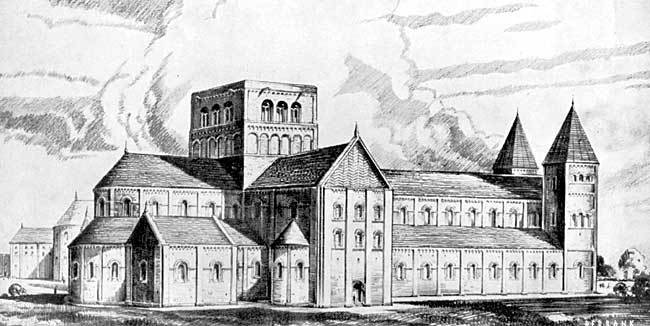
Reconstruction drawing of Lenton Priory (R H Elliott and A E Berbank, Lenton Priory: Excavations, 1943-1951, Transactions of the Thoroton Society, 56, 1952).
I. The History Of Lenton Priory.
WHILE the royal castle of Nottingham yet remained a construction of wood and earth, there arose, little more than a mile away and within view of the defenders of the castle, the Priory of Lenton, built in the massive stonework of the Norman style.1 In the proximity of the monastery to the town of Nottingham may be found an important reason for the failure of the monastic buildings—apart from foundations and a few scanty remains above ground—to survive until the 20th century. After the Dissolution, many monasteries were turned into farms or houses of the gentry. Many others, including the one at Lenton, became quarries, but the fate of the monastic buildings here was not finally sealed until the rise of industrialism in the 18th and 19th centuries caused many people to seek habitations, if not homes, in the town of Nottingham. As a result of the refusal of the burgesses to allow the construction of houses and factories on the common lands surrounding the medieval limits of the town, a ring of villages within easy reach shared with the county town the rapid rise in population. In Lenton the population rose from 893 in 1801 to 23,872 in 1901.2 On the site of the monastery, even of the nave of the church, houses and streets were built. But the nearness of the Priory to the town of Nottingham, which has helped to prevent the survival of any considerable proportion of the conventual buildings, increased the importance of the monastery while the monks were still in possession. Its endowments, greater than those of any other monastic foundation in the county, added to its influence. But of all the factors governing the history of Lenton Priory perhaps the greatest was its connection with Cluny and the Cluniac Order.
The ideal upon which the Cluniac Order was established was the existence of a great central monastery with subordinate establishments spread over many lands and closely dependent on the mother house. Hitherto, the monastery had been self-centred, and any bond of union had been of the loosest description. The Cluniac houses, being directly under the supervision of the abbot of Cluny, the autocrat of the Order, were styled priories, not abbeys. The abbot was the supreme head of 200 monasteries, with the same authority over all Cluniac monks as over those of the mother house. He could transfer any monk from one house to another, and he alone was able to receive the professions of monks. Thus, English Cluniacs were bound to cross the seas and take the long journey south through France to Cluny, unless the abbot came to England. This he did five times in the 13th century, and only twice in the 14th.3
The monastery of Cluny was founded in A.D. 910 by William, Duke of Aquitaine. It was situated about twelve miles north-west of Macon in the duchy of Burgundy.
This region, described by one writer as the crossroads of Europe in the Middle Ages, lay between northern and southern France, and was connected by trade routes with Germany, the Low Countries and Spain.4 Its situation and privileges—particularly that of exemption from episcopal visitation—were well suited to the international character of the organisation of the Order of Cluny. But there were many difficulties in the way of the effective control of the numerous dependent priories by the mother house. Communication in the Middle Ages was difficult and slow. Growing national feeling in England was unfavourable to the existence of monasteries autocratically ruled by a head residing in a foreign country. The Papal Schism of 1378, during which France recognised the pope at Avignon and England the pope at Rome, interfered with the relations between Cluny and its English houses until 1409, when both countries recognised the same pope.5
In the story of Lenton Priory, the influence of these forces may readily be seen. In fact, the varying degrees of control exercised by Cluny over Lenton make it convenient to divide the history of the monastery into four distinct periods:—
(i) From the foundation at the beginning of the 12th century to the beginning of Edward I’s wars with France;
(ii) From the beginning of Edward I’s wars with France to 1392, when Lenton Priory was naturalised and no longer regarded as an alien priory; (iii) From 1392 to the end of the 15th century, when the last of the ties with Cluny were broken; (iv) From the end of the 15th century to the Dissolution in 1538.
(iii) From 1392 to the end of the 15th century, when the last of the ties with Cluny were broken;
(iv) From the end of the 15th century to the Dissolution in 1538.
(1) E. L. Guilford: Nottingham, p. 67.
(2) Victoria County History of Notts., Vol. II, p. 313.
(3) For the organisation of the Cluniac Order see A. Hamilton Thompson : English
Monasteries, 2nd edition, 1923, p. 11; Cambridge Medieval History, Vol. V, Chap,
xx ; Medieval England (ed. H. W. C. Davies, Clarendon Press) 1924, p. 350 ; English
Monastic Life (Gasquet, Methuen), 1904, pp. 217-218 ; “The Cluniac Order and
its English Province,” by Miss Rose Graham, M.A., F.S.A., F.R.Hist.S., in the
Journal of the British Archaeological Association, 1922.
(4) “The Cluniac Order and its English Province,” by Miss Rose Graham, M.A.,
F.S.A., F.R.Hist.S.
(5) “The English Province of the Order of Cluny in the Fifteenth Century,” by
Miss Rose Graham, M.A., F.S.A., F.R.Hist.S.. in the Transactions of the Royal
Historical Society, 1924.