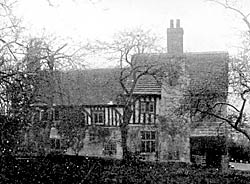
Kirkby Old Hall, c.1900. The house was tragically demolished in the 1960s.
About half a mile further down the valley is an ancient building known as Kirkby Old Hall situated on a slight eminence overlooking the hill brook. The present building is early 17th century, but has traces of a much earlier date, and was at one time known as Sacheverell Hall. The Sacheverell was one of the most ancient and important families in Derbyshire, and branches of it are found in many parts of the country. William Sacheverell married Agnes, daughter of Richard de Kirkby, early in the 15th century, the hall finally passing to Sir Richard Coke of Trusley, who had married Mary Sacheverell in 1574. A local legend is to the effect that "Fair Rosamond," the mistress of Henry II, was born in it, but, as Dr. Johnson wrote, we may leave it to those "who listen with credulity to the whispers of fancy."
Further up the stream is another ancient house, mentioned in a perambulation of Sherwood Forest in 1251, where it is stated: "The marks and bounds of the wood of our Lord the King of Fulwood begining at the brook going beside the ground of Roger of Heilbrooke ..." Through this ground the brook ran, giving the name of Hillbrook House to what is now known as Brookhill Hall. This house passed in 1391 by the marriage of Margaret Sulney to Sir Nicholas Langford, and they sold it to the family of Coke in 1567, who largely added to it. The will of Frances Cooke of Kirkby-in-Ashfield was proved 9th August, 1594, at York. The history of this family is most interesting. One of its members was largely instrumental in founding the old Midland Railway in 1832.
On a hill, opposite to the site of the castle, are the ruins of a wall of a large house which Sir Charles Cavendish, the third son of "Bess" of Hardwick (later Countess of Shrewsbury) began to build in 1598. There is an interesting story of this Sir Charles Cavendish which was narrated by Sir John Chamberlain writing to Sir Dudley Carleton on 28th June, 1599:—
Intelligence of an encounter between Sir Charles Cavendish and John Stanhope. About 9 a.m. Sir Charles Cavendish passing from the new building near his house in Sherwood Forest [Kirkby Hardwick] where he and his lady sleep, to a brick kiln a 1/4 of a mile off with only Henry Ogle, Lancelot Ogle his page and one horsekeeper saw about 20 horses on a hill side and took them for Sir John Byron and his company hunting. But as they gallopped towards him he perceived himself betrayed and put spurs to his horse which fell with him, and before he could gain his feet or draw his sword, two pistolls were discharged upon him, and he received a bullet and several small shot in his thigh. Yet, after this he and his two men and boy unhorsed six and killed two upon the spot. A third fell down in the forest and is thought dead, and a fourth is unlike to live. Some workmen without weapons came up, and John Stanhope fled with all his party. Sir Charles has also small hurts in the head and hand but there is no great danger. He and his three had rapiers and daggers only. Six good horses were left behind, some worth £20, etc., etc.
This occurrence being duly reported to Queen Elizabeth, the Council by Her Majesty's directions ordered both parties to give securities to the Sheriff for their good behaviour.
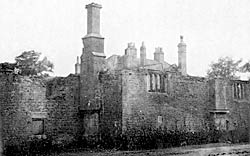
Kirkby Hardwick, c.1900. The house was demolished in the 1960s.
On account of this quarrel and blood having been shed, Sir Charles ceased to build. Instead he purchased Welbeck Abbey from Robert Booth and Ranulph Catterall, and took up his residence there, leaving in Kirkby a wall as a reminder of what might have been.
On the eastern border of the parish stands another important house known as Kirkby Hardwick. In nearly all the perambulations of Sherwood Forest this place is given as a boundary mark.
In its grounds, the stream named "Derwent" [in a map c. 1390, now in possession of the Duke of Rutland] takes its rise, and shortly joining another coming through Sutton-in-Ashfield is called "Aqua de Mam," but now the Maun.
Professor Eilart Ekwall, author of English River Names, writes :—
This name [Maun] evidently does not contain a river name but may be compared with Mam Tor, the name of a hill in Derbyshire (1,700 feet), and the Mam occurring in Irish and Scottish names of hills. The source of the latter is Irish: Mam, "a breast," identical with Welsh Mam, "mother," "womb."
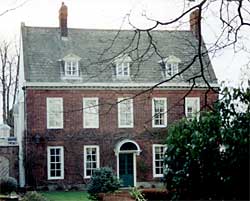
The Rectory dates from 1717 (photo: A Nicholson, 2004).
To me it seems most probable that Mam was once the name of one of the numerous rounded sandstone hills near Mansfield, that the hill later came to be called Mammeskeued, and that Mansfield contains the hill name. This hill overlooks the stream where the Aqua de Mam runs, and seems undoubtedly to be the name given to Mamesfelde—the name given to it in Domesday Book. That part of Kirkby Hardwick now in ruins dates from the time of Edward IV. The enclosing wall was loopholed for defence during the civil war, while the later part of the house, built in 1672, was modernised by Henrietta, countess of Oxford, Holies and Mortimer about 1750. It had passed through the hands of many distinguished owners, including the earl of Shrewsbury, who bought it in 1517. In connexion with the house, the following account of Cardinal Wolsey's last journey, written by George Cavendish in 1557, is of interest:—
And the next day he took his journey with Maister Kyngston and the gard. And as soon as they espied ther old mayster in such a lamentable estate lamented hym with weping eyes. Whom my lord toke by the hands and dyvers tymes by the way as he rode wolde talke with theme some tyme with oon and some tyme with an other. At nyghte he was lodged at an house of Therle of Shrewsbury called Hardwyke Hall; very evyll at ease. The nexte day he rode to Nottynghame.
The old gateway up to which the cardinal and his "gard" rode on November 26th or 27th, 1530, still stands.
And so we take leave of this town and its history with the note that coal pits have destroyed most of its charm, and the ground once trodden by kings, noblemen, bishops, yeomen and villeins now houses a large population of miners. They have proved themselves to be worthy heirs of its past greatness. Of many of them it may be said, in Tennyson's words, that they are "sons of God and kings of men in utter nobleness of mind."