Broxtowe Hall
BROXTOWE HALL IN HISTORY
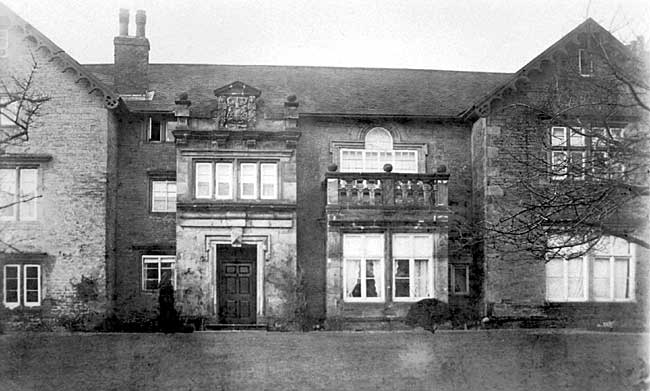 Broxtowe Hall in the 1920s. The Hall dated from
the mid-17th century and was demolished in 1937.
Broxtowe Hall in the 1920s. The Hall dated from
the mid-17th century and was demolished in 1937.The association of Broxtowe Hall with the Pilgrim Fathers and the Mayflower migration (briefly commented on in our leading columns yesterday, and also noted in our review of the timely "New Light on the Pilgrim Story," by the Rev. Thomas W. Mason, in collaboration with the Rev. B. Nightingale, M.A., Litt.D.), seems to have come as a "discovery" to many Guardian readers whose local view of the subject had probably been obstructed by the more prominent claims to notice of Scrooby, Austerfield, and Sturton-le-Steeple. Broxtowe Hall is well worth all the enthusiasm it evoked from our authors by its charming old worldliness, and the wealth of its historical and romantic associations, but we cannot think its existence and its name are so unfamiliar to the ordinary man in the street of Nottingham as they would suggest. For generations, Broxtowe Hall, with its delightful labyrinth of lanes and footpaths, and its beautiful woods, famous in late spring for their gorgeous blaze of bluebells amid the bracken, has been a favourite haunt of pedestrians, and it is still one of the most unspoilt walks within easy reach of Nottingham. To the intimate connection of Thomas Helwys and his brave wife Joan with the Pilgrim Fathers, which cost, them dearly, we need not further refer, but their story does not exhaust the historic wealth of the place. Broxtowe takes its name from Brocul, who in ancient times was the holder of the "stoe," or place, and it was made one of the six wapentakes of Nottinghamshire when King Alfred divided England into its present counties. Centuries afterwards Sir Hugh de Willoughby, the famous explorer, lived there.
NOTTINGHAM ROMANCE
More than once Lucy Hutchinson, wife of the famous Parliamentarian governor of Nottingham Castle, speaks of Broxtowe Hall having to be defended against the Royalists during the Civil War. Round the name of Captain Thornhaugh, a Puritan commander of the fort, is a halo of romance which, has been exploited, we believe, by more than one writer of historical fiction. The story is well told in Robert Mellors' "In and About Nottinghamshire." Captain Thornhaugh is said to have rescued from violation Agnes Willoughby daughter of the occupant of the near-by mansion of Aspley Hall, a Royalist and a Papist. As Agnes was returning home from Bilborough, she was attacked by three ruffians of a kind, half-soldiers, half-robbers, who then infested the country in gangs. The captain, hearing her cries of distress, went to her aid, and shot one of her assailants, whereupon the others made off. Quite naturally, a warm attachment sprang up between the two but their mutual love was overmastered by their hatred of each other's religious creed. During a attack on Shelford and Wiverton, Captain Thornhaugh was fatally wounded. Agnes Willoughby was heartbroken. She vowed never to marry, but to devote herself to prayer, fasting, and alms-giving. She kept her word, and died, expecting to meet the Puritan where creeds do not divide.
THE HELWYS FAMILY.
BROXTOWE AND THE PILGRIM FATHERS.
A PURITAN MEETING PLACE.
Attention has already been drawn in our columns to the associations of Broxtowe Hall with the Pilgrim Fathers. A correspondent now sends us some further interesting particulars bearing upon the Helwys family, the result of a good deal of research.
The hall, he writes, is pleasantly situated on the brow of a hill, and its defensive position gave it importance. In the old days, Broxtowe was a separate parish, but, losing its status as a parish through depopulation, it was united, on April 6th, 1458, to Bilborough. In the oldest Bilborough Register, one of the signatures, under date 1595, Thomas Helwys, as witness, relating to the old bounds of the rectory of Broxtowe.
To-day, Broxtowe Hall forms a substantial farmhouse, the Broxtowe Wood stretching away to the rear, along the shoulder of the hill. The small field on the north, or north-easterly, side of the house, is still known as the Chapel Garden. Beyond it, are evidences of a bank, or ditch, for defensive purposes. During the Civil War, Broxtowe was garrisoned as an outpost from Nottingham and saw fighting, in which it received considerable damage.
There are variations in the spelling of Helwys, which appears also as Herwis, Helwiss, Helewyse, Elwis, Elwaies. An early mention of this name is 1243, when on the day of the Annunciation, Richard, son of Helewyse, witnessed a charter granting lands from Hugh Dukemanton to Abbot William and his convent at Welbeck. A member of this family, John Helwys was instituted to the vicarage of East Retford in 1497, and in 1506 also obtained the rectory of Hayton and Ordsall. A marble slab in East Retford Church records his death in 1511.
AN ASKHAM CHARITY.
The next of the family was Robert Elwes, of Askham, who founded a charity which still exists, and now shelters three aged widows of that parish. Robert was succeeded by his son, William, who had a large family, and who also was an extensive landowner at Everton. He was buried at Askham in 1557.
William's son, Edmunde, is the first of that name who lived at Broxtowe. He entered one of the Inns of Court, and appears to have been fond of religious topics. He wrote a curious book, published in 1589, called "A Marvell Deciphered." His will, dated 1590, drawn up by himself, is prefaced by a personal confession of faith.
Thomas Helwys succeeded his father Edmunde. He appears to have been a young man at the time of his father's death. The latter requested in his will that his body should be buried in Bilborough Church, near his "pue door," and under a stone upon which should be carved his first coat of arms. After carrying out his father's instructions, he was admitted to Gray's Inn in 1593. He returned to Broxtowe in due course, and was married to Joan Ashmore on 3rd December, 1595.
Seven children were born to them. The first two were baptised in Bilborough Church—John in 1596 and Thomas in 1603. There are no records of the baptism of the other five, whose names were Gervase, Margaret, Elizabeth, Margaret (a second Margaret), and Winifred. So we may reasonably suppose that his views on infant baptism underwent some change after the birth of the second child.
A PURITAN CENTRE
The Broxtowe home now became a centre and place of call for the Puritans of the district. Here John Smith (known as the "See Baptist") and other Separatists found a haven of refuge. This John Smith is said to have founded the Baptist sect in this country. Smith and Helwys were close and intimate friends, and they went heavily together in the way of separation. The High Court of Ecclesiastical Commission for the Province of York took active proceedings against members of the Gainsborough and Scrooby congregations in the autumn of 1607. This caused many to leave this country for Holland, and Thomas Helwys appears to have followed them, leaving has wife and children at Broxtowe.
In 1608 she was under arrest in York Castle for refusing to take an oath according to law. On regaining her liberty she does not appear to have rejoined her husband in Holland. From a book he published in 1612 we gather that he believed the Roman Catholic Church was wrong, the Anglican Church was wrong, Puritanism was wrong, all other "isms" the same, and the stupendous task of setting the world right had been laid upon him. If James Stuart could be brought to see "eye to eye" with Thomas Helwys there would be hope for religion in the land.
As Helwys had kinsmen of good standing in London he settled there, and it appears was the founder of the Baptist party in London. The date of his death is not known (it was before 1620), but his life there was not without trouble, for there are several references to his confinement in prison. Some of his companions in Holland were amongst the Pilgrims.