The Church
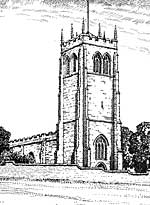 St. Mary's, Greasley before the restoration
of the church.
St. Mary's, Greasley before the restoration
of the church.DEDICATION.
The Parish Church of Greasley is dedicated to Saint Mary the Virgin and it is reasonable to suppose that this has been so ever since a church has stood here.
In days gone by it happened not infrequently that the dedication of a parish church was altered in order to reduce the number of holidays and "feasts," and consequently many dedications were transferred to St. Mary and the festival observed on Lady Day, March 25th.
In the case of St. Mary's, Greasley, however, the dedication festival has always been on September 8th, the day of the "Nativity of the B.V.M." The local Hill Top "Wakes," still held annually in the parish at the beginning of September, is a survival of the ancient "revels" and "feastings" associated with the dedication festival of the parish church. To-day (here is little to connect the two, though each survives in separation.
THE ANCIENT BUILDING.
It is quite possible that a church has stood on the present site for a thousand years or more, for mention is made in the Domesday Survey (1086) that a church and priest were here at that date.
All that now remains of this church are the chancel walls which, best seen from the outside, consist of irregular, undressed stones.
The tower comes next in age; crowned with eight pinnacles, it is a fine example of the Perpendicular style, and was probably built by the Cantelupe family about 1450.
Between 1086 and 1450, the church must have undergone much repair work and no doubt was at its "ancient best" in the period 1350-1450 when the Cantelupes lived at Greasley Castle.
REPAIRS TO BUILDING.
After their time it may be assumed that the church was less cared for, as in 1753 repairs were effected at a cost of £1,530, a considerable sum in those days.
Even so, much necessary work must have been left undone for extensive repairs were again undertaken in 1832.
THE CHURCH OF A CENTURY AGO.
The state of the church in 1866 is described in detail by the Rev. Rodolph Baron von Hube who became vicar in October of that year. He records in his book on the history of Greasley (published in 1901) that the outside chancel-walls were skirted with thick stone slabs to a height of about three feet to strengthen and protect the defective masonry. These may still be seen,
He informs us also that inside the church a brick wall surmounted by boarding completely shut off the tower from the nave. There were large galleries in the nave, the pews were of the horse-box type, and the pulpit was a two-decker.
How drab and ugly it must have been!
In 1882, a partial restoration was carried out at a cost of £900.
Defects in the outer walls were made good, the partition which separated the tower from the nave was removed, as were also the galleries; a small vestry was made by walling up the door of the old priest's porch and inserting a window, the nave was re-floored and re-seated, and all windows re-glazed.
A few years later, subsidence due to coal mining operations caused great cracks to appear in the masonry, followed by the breaking away of the nave from the tower and the chancel from the nave.
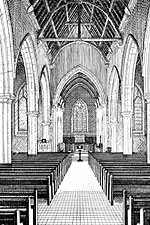 The interior of the church after the restoration
in 1896.
The interior of the church after the restoration
in 1896.THE RESTORATION OF 1896.
When all movement had ceased, a major restoration was undertaken in 1896. The roof of the chancel and nave was removed, and with the exception of the chancel walls and the tower, the church was practically rebuilt. Part of the old east window was erected in the vicar's vestry as a relic, and this, with the chancel walls and the tower, make up all that remains of the ancient church. This restoration of 1896 cost £2,000 and was met in full by Earl Cowper, the Duke of Rutland, and Messrs. Barber, Walker and Co., the coal owners.
CHOIR VESTRY AND ORGAN.
In 1910 further improvements were made to the fabric and furnishings of the church by the addition on the north side of a choir vestry at a cost of £600, and by the gift of a fine organ presented by Major Thomas Philip Barber, D.S.O., of Lamb Close, one of the present churchwardens.
THE BELLS.
In 1922, attention was turned to the bells. There were four bells in the tower in 1866 and two of these were re-cast and a fifth added in 1869. The oldest is pre-Reformation and is thought to have once been in Beauvale Priorv. In 1922 it was decided to make a peal of eight, and for this purpose three of the existing five bells were re-cast and three more added, and the whole peal suspended on a steel framework.
This improvement cost £1,500 but was well worth it, and to-day Greasley possesses one of the finest set of bells in the Midlands and is a veritable Mecca for ringers from near and far.
The interior of the church after the restoration in 1896
The interior of the church showing the 1914-1918 War Memorial Screen
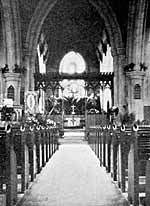
The interior of the church showing the 1914-1918 War Memorial Screen.
THE CHANCEL SCREEN.
In 1919, a carved oak chancel screen was erected as a Memorial to the Fallen of the 1914-1918 War. There are 67 names inscribed on the panels including that of Airwoman L. Cecelia Holmes.
Here we might mention that Major C. M. Merritt, whose name appears first on the screen, was twin brother of Mrs. T. P. Barber, of Lamb Close. His son, Lt.-Col. C. C. I. Merritt, took a leading part in the famous and daring raid on Dieppe in 1942. He was the first Canadian V.C. of the World War and was awarded the decoration for "matchless gallantry and inspiring leadership while commanding his battalion."