< Previous | Contents | Next >
EDWINSTOWE
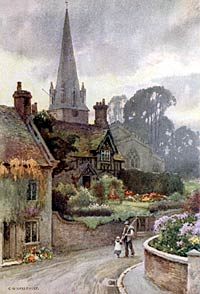 Edwinstowe in 1910.
LONG before the Norman Conquest the Saxons had settlements here, and in other parts of the district. But, ancient as these settlements are, little is actually known of any events of importance having occurred in them. In all probability the village owes its origin to a clearance in the dense forest, for until comparatively recent times it is known to have been almost entirely surrounded by trees. Bilhagh and Birkland extending from the north-east to the west, at which point until the time of the Commonwealth, Birkland would unite with Clipston Park, and that park on the southern side joining the South Forest and Rufford, the circle was almost complete.
Unlike Clipston and Ollerton, Edwinstowe is not known to have had any family of historic note actually seated there, and this circumstance in some measure accounts for the scarcity of recorded events. But when the situation of the village is considered, its contiguity to Clipston and Thoresby, the former frequently the residence of the Plantagenet kings, one feels certain that many interesting events must have happened in connection with it, but of which, unfortunately, there is now no information. When the king sojourned at Clipston, Edwinstowe must to some extent have shared the stirring life of the times. In imagination one may see the royal huntsman, with his courtiers and their followers, passing by the huts of the foresters, as they must frequently have done when in pursuit of their sport; or hear the jangling of the trappings of the horses as they pass at leisurely pace, on their return when the day is over, followed at a distance by their attendants bearing the spoils of the chase. And perhaps, when the cavalcade has gone by, there creeps stealthily from the hollow trunk of an oak-tree near the church a figure, apparently of a man, though barely distinguishable from the wild beasts of the forest, for he is clothed in a rough, worn, and weather-stained garment, made from the skin of some animal, reaching from his throat to his knees, and giving him a half savage aspect. Why is that scowl upon his face? Is it that he is starving, and has killed one of the king's deer, and knows that if he is taken his life will be the forfeit?
It is very likely that on the institution of those severe punishments for offences in connection with the forests, when Sherwood had its special staff of officers, all sworn to carry out its enactments, that, from its peculiarly favourable situation for keeping watch on marauders, Edwinstowe would be the habitation of a number of these officials. They must frequently have come into collision with men who, from various causes, made themselves obnoxious to these laws. At a much later date than the time of the Plantagenets, Sherwood is known to have been so thickly overgrown with trees, and the branches so intermingled with each other, that there was difficulty in keeping on its paths. What a retreat this would be for Robin Hood and his followers! Under a leafy shade they might wander unseen to Mansfield and Nottingham in the south, and to the Yorkshire coast on the north. Edwinstowe being in the heart of the highway, as it may be called, many dramatic incidents must have occurred here between these men and the officials. Their deeds, without doubt, would be talked of round many a fire in the rude huts in the village, and traditions would probably linger long afterwards, but time has effaced all memory of them.
In the reign of Henry II., 1168-69, Edwinstone contributed three marks and Clipston one mark to the subsidy levied for marrying the king's daughter.
In the reign of Edward III., Henry and Robert de Edwinstowe, clerks, two brothers, granted to the Abbey of Newstead "the whole manor of North Muskham, on condition of the finding of two chaplains to celebrate divine offices for ever, daily, in the church of the blessed Mary of Edwinstowe." The deed confirming this grant was exhibited at the meeting of the British Archaeological Association in 1863. In 1335, Thomas son of Henry de Edwinstowe, was vicar of the church. In 1342, Henry de Edwinstowe instituted William de Babworth as warden of the chantry of Edwinstowe. In the year 1332, also, the name of Henry de Edwinstowe, clerk, appears in a charter from the king granting certain privileges to the Abbey of Rufford. All other records of this family appear to have perished.
As early as the reign of Henry IV. the men of Edwinstowe had permission granted to hold a yearly fair, lasting two days.
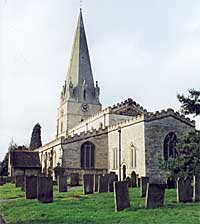 Edwinstowe church (A Nicholson, 2003).
The church, which stands at the northern end of the village, has evidently been built at various times, the most ancient part being the tower. In the seventeenth century the whole fabric was said to be in a ruinous condition, caused principally by the fall of the spire, and the inhabitants of Edwinstowe forwarded a petition for permission to appropriate two hundred oaks out of the hays of Birkland and Bilhagh, of the value of £200, for its repair. Until recently the walls and ceilings of the interior of the church were covered with plaster, which has now been removed, and a new open-work roof of oak erected, restoring these parts of the building to their original state.
In the north aisle is a marble monument to the memory of Gulielmus Carter, which is good in design and well carved. In the south aisle, another monument, to the memory of William Villa Real, who died in 1759, is interesting. He resided in a house near the river, which has since been taken down and rebuilt on higher ground. The house still bears the name of its former owner, "Villa Real."
The stained glass in the south window of the chancel, to the memory of Mrs. Cecil Foljambe, the first wife of Mr. Cecil Foljambe, of Cockglode, is a pleasant piece of colour, and a fine specimen of modern work.
In the churchyard, though a few of the monuments are in good taste, there are many that are far different; but the crudity and vulgarity of the stones erected not many years ago are already softened by lovely lichens of almost every colour.
Henry Tinker, clerk, vicar of the parish, made his will in 1584, "giving his soul to Jesus Xt, and his body to be buried in the churchyard of Edwinstow, under a great stone that lyeth near the quere door."1 The name of Henry Tinker occurs among the list of vicars of the parish. He held the living for thirty years, but the "great stone near the quere door," and all other memorials of him, have disappeared.
At the vicarage which adjoins the churchyard, Dr. E. Cobham Brewer, author of many educational books and works of reference, took up his residence in 1884, with his son-in-law, the Rev. H. T. Hayman. He was the second son of John Sherren Brewer, born in Russell Square, London, in 1810, and educated by private tutors, and at Cambridge. Took his degree in the Civil Law (first class), in 1835, became LL.D. in 1840, and devoted himself to literature. From 1852 he resided for six years in Paris, and afterwards in London, but failing health compelled him to retire to the country, and he lived for many years at Lavant, near Goodwood. All through life Dr. Brewer had been an eager seeker after information on almost every conceivable subject, but especially in relation to science; and never averse to opening his stores of knowledge to any one with whom he might converse. He related that The Guide to Science had its origin in a habit he had in his youth of entering in a book all questions on matters (especially scientific) which he could not explain for himself. The book was similar to those used for writing lessons, but specially ruled with a space for the question, and another for the answer when it was obtained. This was done for his own use, and eventually the manuscript was bound up into a thick volume. He asked the opinion of a scientific man on the value of his work, and the advice he received was to burn it! This advice, however, he disregarded, and some time afterwards submitted the volume to a publisher, offering the copyright for fifty pounds. This was declined, but the publisher agreed to bring out the book at his own risk, he sharing the profits with the author. The work went through many editions and had an enormous circulation, proving extremely profitable to both parties.
By request of the Emperor Napoleon III. a French translation was prepared for the use of the Prince Imperial. It was also translated into other European languages—among the rest, a Greek version was published at Smyrna in 1857. After The Guide to Science, perhaps the most widely known of Dr. Brewer's works is the Dictionary of Phrase and Fable, of which he published a new and greatly enlarged edition, the hundredth thousand, shortly before his death. He was of a kindly disposition, and remarkably cheerful. He died, after a short illness, on March 6, 1897, in his eighty-seventh year, and was interred under a marble monument in the churchyard at Edwinstowe, near the entrance to the vicarage grounds.
Every one interested in the village owes a debt of gratitude to Dr. Marshall for transcribing and publishing the Parish Registers. The manuscript volumes are in a most dilapidated condition, and are said to be past repair. It is a pity this should be the case, for the quaint remarks of the parish clerks (for three generations of the name of Emley), on domestic and other matters, though they are few, have an interest from the old handwriting, which cannot be transferred to the most beautiful of modern printed books. Many of the names seem to be indigenous, and suggest old forest days—such as Freeman, Trueman, Beardall, Billyard, Tudsbury. Their descendants still live in the village.
Here are some episodes of life and death in the seventeenth century:—
1655. "22 July. Thomas Stothers father of a family, Clipstone, 'who the night before as it was supposed about 6 a clock in the afternoone came a horse back full of drinke, & rideing on the way downe a litle hill called Broadickdale comeing from Ollerton, there in the way fell from his horse & was psently in the way found, but dead, might be supposed he fell on his necke, his frendes not well satisfyde how he came to his death caused him the Tusday night after to be taken vpp again, & the man who found him first, with another jury of men & Coroner, to see that man touch him again, wch as an inocent man many at that time did see. From which suddain accedents & destinyes Good God in his mercy deliver vs all. Michaell Emley, senir, Aughust 12th, 1655.'"
Among the marriages in 1659:—"22 Nov. Thos. Millner & Eliza Stock both of Budby. 'They was Maryed as it was reported in the house of Mr. Bowes by him now vica Because Bailiffs was in Towne to arrest ye vica.'"
On the 8th of January, 1643, was buried "Thomas Chan-tyre 'Who dyed in an Oven at Clipston, who went in to be cured of an ague."'
Sepr. 17th, 1644, was buried "Anthony Dynall. Edwinstow. 'Who kept a great stock of sheep & dyed Bat-cheller.'"
Feb. 8th, 1645, was buried " Robert Collingham. Edwinstow. 'Who said he was never troubled with headake in all his life.'"
June 22nd, 1656. Burial. "Roger Bagnall, who was drowned by swimming" (?) " over the forge dam at Clipston."
"Memorand. 1669 the eigth day of Jan. Marye levers began to milk our cow."
Although these memoranda by the parish clerks are not of general interest, yet, considering the dearth of incidents from other sources, one is grateful for them. Would that there was as much information on the life of the village in some previous centuries.
Those who think that art has made rapid strides in England during the last three hundred years, will certainly find no confirmation of their opinion in the handwriting in this register. It is excellent and picturesque at the commencement, but gradually becomes commonplace and slovenly.
< Previous | Contents | Next >
1 The Registers of Edwinstowe.