Basford
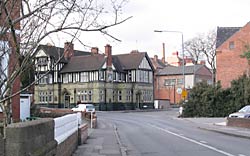
The White Swan pub on Church street, Basford.
Boundaries. The boundaries of the old parish of Basford stretch from the moat of Broxtowe Hall, defined by a line including Whitemoor, part of Mill-in-the-Hole, by Shipstone and Gladstone Streets, cutting across Carrington Station, and by Redcliffe and Woodborough Roads, Scout Lane, part of the Daybrook Valley, by the Bestwood boundary to near to Bulwell Forest, and dividing the Basford Workhouse, Bagnall and Cinder Hill. The acreage is 2893, and the ground is very undulating, varying in altitude some 250 feet. The soil on the extreme west is on limestone, in the centre on sand, and in the east on clay. It has a river, several brooks, and many springs.
Name. The word "Base" possibly has reference to lowness of position. There may have been three fords over the Leen at Basford, and the lowest one would be near to the Church. Dr. Mutschmann, in his forthcoming book "The Place-names of Notts., their Origin and Development," suggests the possibility of the derivation being from "the ford near which Bassa lived."
Geology. The coal on the western side is reached at a depth of about 150 feet, but is not commercially workable. At Newcastle pit, sunk in 1853, there are seams at 172 feet, 286 feet (2 ft. 10 in.) and the Top Hard which is being worked is 5 ft. 6 in thick, and is 406 feet from the surface. The mighty convulsions of nature, as well as its slow processes, have covered over what was here the surface of the land, and hidden the valuable deposit until it was wanted.
The Magnesian Limestone, about 20 feet or less in thickness, is seen to the best advantage in Bulwell Quarries, and near the "Colliers Arms," Cinder Hill, and in the cutting between Nuthall and Kimberley. The Lower Mottled Sandstone overlaying the Limestone is exposed in a quarry opposite Two-mile Houses, and has a good example of the various currents that influenced its deposit in the Railway Quarry at Hempshill. The Pebble Beds are well exposed in Hucknall Road, and Edward's Lane. The Keuper Marl is best seen in the Mapperley Brickyards.
The River Deposit in the Leen Valley consists of ten or twelve feet of loose sand and vegetable growth, peat, apparently on the bed of a marsh, with a similar depth of gravel; so that any heavy burden placed on the top is liable to sink somewhat, for here we are on the bed of a great ancient stream. According to Mr. Shipman there is a bed of ten feet of "Torrential Gravel," and two to six feet of Glacial Drift (pebbly loam) deposited during, or shortly after, the Great Ice Age, when the Leen Valley was occupied by a broad sheet of water swiftly moving to the Trent. Vernon Eoad is on peaty ground. What a wondrous record has the dirt under our feet!
Saxons. We have to leap over vast ages of time in which we have no records or traces of British or Roman occupation of the parish, nor do we know when or how the Anglo Saxons, or Danes, came and settled. A great part of the parish would be forest, part being sandy waste, and part, especially to the east, woody It is probable there was a church, round which plots of land would be cleared and cultivated in strips, in three fields, controlled by the community. It must have been a place of some importance, for Alwin, Alfag, Algod, Alvric, and Escul, the Saxons, had six manors, estates, or farms which they owned and cultivated, and for which they were for about 500 acres, in the whole, assessed to the Danegeld, or land tax, but at the Conquest all their lands were forfeited, except that Alvric, one of the King's servants, was allowed to keep about sixty acres.
Normans. At the Conquest most of the land was given to William Peverel, the lord of Nottingham Castle ; and his men were Safrid and Pagen; and two holdings of about fifteen acres each became waste There was one soc-man, or ordinary tenant; five villein tenants, who were subject, and bound to cultivate their lord's manor farm; and ten bordars, who were cottagers, and went, or were transferred with their families when the land was sold There were five mills, doubtless on the Leen, rendering, or let for 25s 4d, and 16s. The water power for grinding was therefore well used. For present values multiply thirty times. There were seven acres of meadow, one of woodland, and some underwood. The values were put for rating purposes at 80s. There was a priest, and it is reasonable to suppose there was a church, but this is not named. Both Safrid and Pagen's son gave tithes to Lenton Priory.
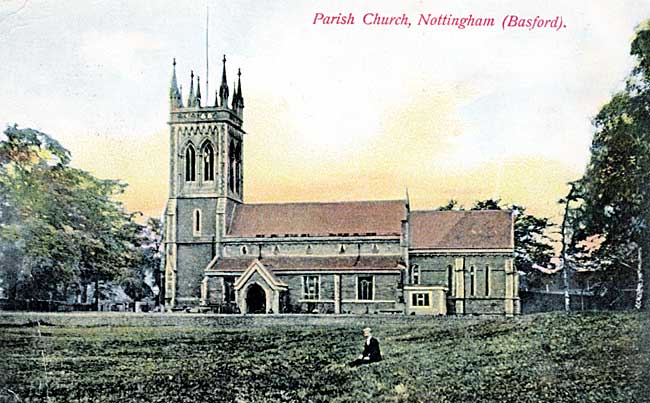
St Leodegarius'church, Basford.
The Church. The Church dedicated to St. Leodegarius dates back to 1127, or nearly eight hundred years. It has been several times restored, and formerly had a spire steeple. The main walls are old, and contain some good Early English work, and it retains many objects of interest, including a fine Gothic doorway, a low side window —erroneously called a leper window—a credence table, a kissing stone, in honour of some Pope unknown, the base of a holy water stoup, etc. The windows were formerly decorated with armorial bearings. Robert de Basford, grandson of Safrid, one of the men who came with the Conqueror, gave the Church which he had built, and dedicated to a French saint, with its lands and tenements to the prioress and nuns of Catesby, in Northamptonshire, of which Priory he was the principal founder. The Church was then probably a thatched building, with reeds on the floor, and without seats. St. Leodegarius, or St. Leger, as he is usually called, was born in 616. He became Abbot of St. Maxertius, in Poitiers, France, and afterwards Bishop of Autun. or Verdun. In 670 he incited many canons, chiefly for the reformation of the monasteries. In a revolution in 678, the city of Autun was attacked, and Leodegarius to save the city gave himself up, and his enemies put out his eyes, maimed his tongue, cut off his lips, and two years afterwards beheaded him in a wood, lest he should be honoured as a martyr, which honour, however, came three years after his death.
Two of the bells are dated 1606, and one is much older. The largest bell bears the inscription—
"As sweetly tolling men do call
To taste on meat that feeds the soul."
The floor has several times been raised. Mr. Stretton's manuscript says that the floor was very low and damp, and in 1819 was raised half a yard. There was a gallery on the south side of the Church, another at the west end, where the choir sat. Old John Hooton, grandfather of the present choir-master, played the flute, and Gervase Matthews the bass viol. The galleries were removed about 1850, and the horse box pews, and the floor was again raised.
The Registers commence 1561, that of marriages 1568. These have been extracted by Mr. A. Stapleton, and published by Phillimore & Co. In one case an entry at the top of a leaf has been cut out. A sad entry is as follows: "Aaron Leeman and Elizabeth Batterley, 20 Apr. 1810." This entry is deleted by lines in red ink, underneath being written "N.B. The man never appeared." A hundred years later we all exclaim: "Oh! Aaron, Fie on you!"
The Pope in 1171 issued a bull whereby the clergy and laity of each parish went every Whitsuntide to Southwell and joined in the great procession. The Priest and Churchwardens of Basford took 1/1, equal to 27/1 now, as Pentecostal offerings from the parish.
The Manor. The Manor cannot be dealt with here, only occasional extracts must suffice.
When Lenton Priory was founded, Philip, the son of Safrid, before-named, and Maud his wife, gave to the monks, and in honour of the High and Undivided Trinity, twenty-four acres of land in Basford, and other property, and his son, Robert de Basford, gave four bovates (?60 acres) more, and much other land.
Sir Raph Langford, Knight, had considerable land here. "This," says Thoroton, "was a family of principal note." Raph de Crumwell, of the famous family, Gervas Clifton, Sir Wm. Copley, the Earls of Clare, the Cavendishs', Byrons', Willoughbys', Strelleys', etc., have been owners here.
Sir William Ascough was lord of Basford and Nuthall. He, in 1522, married a second time, and his property in Basforth was settled on Trustees for his wife's benefit. He was the father of Ann Askew, or Ascough, the young and beautiful martyr, to whom, and to her horrible tortures, Fox, in his "Book of Martyrs," devotes twelve pages. Nuthall tradition says she was born there. She was burnt at Smith-field in 1546, aged 25 years.
Eland Hall. William de Eland, referred to in page 122, was in 1330 the owner of the manor of Algarthorpe which, according to Mr. Bailey's "Annals of Notts.'' "extended over something like 200 acres of land, and to have stretched in a northerly direction, from the lands now constituting New Basford, including Bagthorpe, to the extremity of the village, bounded on the west through its whole extent by the river Leen " This description is somewhat involved. Wm. Eland's son married into the Strelley family, and they called their house "Eland Hall," and the site of this house appears to have been north of Ashwell's Bleach yard, about where the Gas works now stand, and the Court of Peverel was thereupon removed to Algarthorpe, or Eland Hall, and so continued in the Revel and Hutchinson families, a new Eland Hall having been built a little north of the Church. Eland Street is a reminder of the old hall.
When Henry Eland, of Algarthorpe, Basford, died in 1493 he had among other property an assart, or enclosed field, called Eland Close, within Shyrwode forest, worth 8/- yearly, rendering yearly 2/- to the King.
Rights. The Mayor, Burgesses, and community of the Town of Nottingham in 1352 claimed the right of common pasture in the wood, and in the lings of Basford, within the bounds of Sherwood Forest, but Avery de Sulney, Knight, claimed to be paid for each great beast a penny a year, which, however, he agreed to forego. In 1356, Robert de Cockfield gave a similar release.
In 1385 William Neville, Knight, sued John Breadseller, of Basford, and all the men (or community) of Basford for 14d. for chiminage of the Lord King—that is, a toll for the right to pass through the forest, and John and the community of Basford acknowledged the debt, and the damages were taxed at 2d. (Multiply twelve or fifteen times for present values.)
Stone. Basford stone was used in Nottingham about the middle of the 15th century. There were no bricks, and stone was therefore fetched from the most convenient locality, and it is not unlikely that the road to Codnor Castle, now called Alfreton Road, would be kept in as good a condition as most roads, which is not saying much. Thomas Thurland in 1458 gave twenty loads of Basford stone for the repair of Trent Bridge, and Hoccley, of Basford, was paid for 43 "lode of ston to ye Brygs." In 1496 the Pillory was repaired with it, the price then being 8d. a load, but in 1511 for a load used for the reredose (back) of a chimney 4d. was paid, equal to 4/- now. The great quarry was the mother of many houses, and for a hundred years has been at rest, for it is now a wood, and rooks have taken the place of man, yet the nettles and degenerate gooseberry bushes tell that man has been there. It is west of Cinder Hill, on the farm occupied by Mr. Dexter.
Values. The name of land in Basford in 1478 is shown. Sir Nicholas Langford had eight messuages, 200 acres of land, ten of meadow, and one hundred of pasture in Baseford, which were worth yearly one hundred shillings besides expenses.
In 1513, after the death of Sir B. Langford, a jury said the value was 40/- yearly, besides expenses, and a charge of fraud was made that the King had been deprived of the custody of the infant heir.
Age. The difficulty of proving the age of heiresses before there were Registers of births, deaths, and marriages, was shown in 1509. A Court was held at Southwell with three commissioners and fourteen jurymen. Twelve witnesses attended to prove the age of Mary, wife of Rowland Revell, who was seventeen years of age, and was born at Algarthorpe, in Baceford, in 1492, and was baptized in Basford Church. The witnesses remembered the baptismal day because they were godfathers, or godmothers, or carried a lighted wax torch, or carried a silver font, or a towel, etc. Marriage before seventeen was not wise.
In its Forest days sheep were extensively kept in Basford parish by the Willoughby family. In the Wollaton M.S. it is recorded that in 1566 Hugh Jarlande was shepherd at Basforde with sixteen-score sheep and eleven wethers.
Houses. The state of the houses in Basford may be judged by a lease in 1485 given for twelve years by Henry Eland, of Baceford, gentilman, to William Hegyn, merchaunt, of a meese (messuage) and a close in Baceford which he was to keep in repair "as in thack, morter, daubyng and closing." The main buildings would be partly of timber, with wattle and daub filled in. covered with thatch, having low small windows, and the chimney built of stone.
There are not many old houses left in Basford, The Tinker house is in ruins, but Sycamore Hall stands well, as does also Churchfield house.
Foreigners. ''Pore people from forraine parttes out of the towne" the Nottingham people would not have—that is, persons not burgesses of the town were foreigners. In 1612 Robert Boos had taken William Basforth and his wife into his house at Gray Fryer Wall, and was ordered to get them away before the 1st of June, and in default Basforth must go to Saint John's, which had been a Hospital, but was probably then a poor house.
Conventicle. There was a conventicle (that is a Nonconformist assembly for religious worship) at Basford in 1669 at the house of Mr. Clarke, where "from seventy to eighty ordinary sort of Tradesmen" attended for religious worship, their Heads and Teachers being Mr. Clarke, Mr. Langton, and Mr. Seddin.
Stocks. The stocks stood where the National School now stands, and there was the Round House, or House of Correction, or in other words "The Lock-up" for temporarily detaining offenders. The last man who was put in the Stocks is said to have been one who went into the Church about 1842, drunk, and caused a disturbance, for which he was placed in the Stocks two hours.