Nottingham High School. Dame Agnes Mellers in the remarkably business-like document which is the Foundation of the Nottingham High School, in 1518, provided that in case of negligence, and forgetfulness, or maladministration, by the Mayor, Aldermen, and Council, then the Prior and Convent of the Holy Trinity at Lenton should have the rule, etc. of the School. Thomas Gwyllam, who was then Prior, and his comrades, must have been reliable men, or such confidence would not have been expressed, but had the transfer taken place the pillage by the King and his successor might have deprived Nottingham of the School of which it is justly proud.
Magna Charta. Philip Marc, who was Sheriff of Notts, and Derbyshire, and Lord of the Manor of Bulwell, gave nine bovates of land at Keyworth to the Priory of Lenton, where he desired his body might be honourably entombed. But however honourable his burial might be, he was certainly not honoured in life, for the Barons in the famous Magna Charta make the King to promise:—" 50. We will remove absolutely from their bailiwicks (in addition to eight persons named) Philip Marc, and his brothers, and Geoffrey his nephew, and their whole retinue." The barons evidently meant to have a thorough clearance.
Demolition. After the Dissolution no attempt was made to utilize the buildings, which became for generations a fine quarry from which to carry away the rich tracery, and every adornment that the wealth, art, and piety of over four hundred years could produce. When the work of pillage and destruction began, where would it stop? There was always a tradition that the Priory's near neighbour—Wollaton Hall—benefited at its expense, and this is confirmed by the "Report on the Manuscripts of Lord Middleton preserved at Wollaton Hall," recently published by the Historical Manuscripts Commission. The Hall was built in 1580-8, and in 1591 there appears in the book of hall payments: "To Richard Gamble and his fellow for gettinge 60 ell of stonne at Lenton Abbie at 3d. the ell, XVs.," and there are many similar entries. For generations tooled stones adorned the gardens of the houses in Lenton, and there could be little doubt as to where the stones came from. There was in Thoroton's day one square steeple left, but its stones were used to make a street causeway.
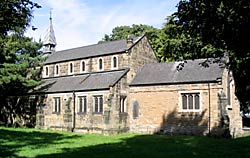
The Priory Church of St. Anthony was originally founded c.1170 as the chapel of St Anthony's Hospital at Lenton Priory (photo: A Nicholson, 2005).
Priory Church. The Priory Church was long the Parish Church but it fell into decay, and was not restored till 1884. Its original foundation is supposed by Mr. Godfrey to have been that of the Hospital of St. Anthony, built for sufferers from St. Anthony's fire. On the altar steps is some beautiful decorated Norman work. There are two priests' slabs, and a few worked stones. Whether the parish church was the nave of the church of the Priory, or a separate building, cannot be ascertained. The present structure, surrounded by trees, stands in ground rendered sacred by the people having there for eight hundred years buried their dead, and persons dying in Nottingham Park were also buried there.
Of the church in which the monks worshipped there are still the bases of two columns, which may be seen in a garden near by. In Mr. Stretton's day, one hundred years ago, there were seven of them. The font removed from that church, and for some years standing in Mr. Stretton's garden, is an exceedingly fine specimen of Norman work, with sculptures both curious and interesting, being sermons in stones, representing the baptism, crucifixion, resurrection, etc., of Our Lord
It now serves its purpose in the new parish Church.
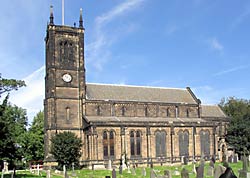
Holy Trinity, Lenton (photo: A Nicholson, 2005).
The Parish Church. The Church of the Holy Trinity was built as recently as 1842, in Early English style, and became the Parish Church. It has several stained glass windows placed to departed worthies, and a tablet and window to the men who fell in the South African War was unveiled by Earl Roberts. It has recently been enriched by a reredos, and mosaic work, and a new organ, the gift of Mr. William Player; and by choir stalls, the gift of Mr. Henry Crewdson. Mr Henry Kirk recently left £500 for the National Schools, and his sister, Mrs. F. Carver, placed a window in the Church to his memory. The tower has a fine peal of bells, and illuminated clock dials.
Co-Workers. The Wesleyans began in 1798, and built their present chapel in 1888, the Congregationalists,—whose excellent minister, the Rev. C. Somervell, M.A., recently left the district—(1883), Baptists (1851), Primitives (1863—1883). United Methodist (1859-87), and other bodies, have chapels and schools, and are vigorously and peacefully carrying on work and worship, education and philanthrophy, and what cannot be said of some places, they frequently co-operate in outdoor mission preaching work, the Vicar, the Rev. A. H. Watts, very properly taking the chair, and all others aiding, for they all have one definite purpose, follow one Master, are guided by one book, hope to arrive at one heaven, and therefore they ought to co-operate in the work of God, and the big things of religion, upon which they agree, are a thousand times more important than the points on which they differ.
Lenton Fair. A Fair of eight days was granted by Henry II. before 1163, to Lenton Priory, and confirmed by King John, and by Henry III. was in 1232 extended to twelve days. These charters, with the growth of customary usuages, imposed restrictions on the inhabitants of Nottingham, and led, one hundred years afterwards, and for centuries, to much ill-feeling and many disputes, as no market or sale could be held in Nottingham while the Fair continued, and in 1517 a compromise with the Mayor was arrived at, whereby food might be sold in Nottingham "within houses, doors, and windows," if the toll was paid to the Prior, but no market bell must be rung, etc. Little did the Prior in A.D. 1300 think that the clever bargain he then made with the Mayor for his rights would be followed by the Priory being razed to the ground and the Fair abolished.
Security. There were no banking facilities in the olden time, and apparently a Priory was the safest place for money to be deposited. Sir Henry Willughby in 1493 being about "to goo with the Kyng my soveraign Lord on his roiall viage in to the parties of Scotland " made his will, having made one four years before, in which he directed that certain moneys should remain in the "Abbe" of Lenton in a coffer under four locks until his son came of age.
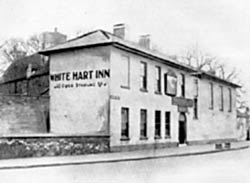
The White Hart, Lenton, in the 1920s.
Peverel Court. The Court of the Honour of Peverel breathed its last in 1849, after a lifetime, it is believed, approaching to 700 or 800 years. It had a bad reputation owing to its harshness, its unreasonable jurisdiction, and its lack of proper accommodation, and from being an almost Royal Court it descended to being a Court for the recovery of small debts. Its jurisdiction extended over one hundred and seventy towns and villages in Notts., and one hundred and twenty in Derbyshire; and as if this was not enough, Charles II. extended it to Chesterfield, Sheffield, Rotherham, etc. Till 1310 the Court was held in St. James' Chapel, Nottingham, and afterwards at the Shire Hall, then at Basford, and later at the White Hart, Lenton, behind which was the debtors' prison. On the walls of a miserable tenement in a back yard, with high walls, and no sunshine, may still be seen the words painted, "Rules of the Prison." Blackner in his "History of Nottingham," page 104, gives an account of a shocking case of imprisonment there, without food, or fire, or ability to pay, and he hopes for the day when "this badge of disgrace may be driven from the earth," and two generations ago this was done.
Tithes. When the forest lands were enclosed in 1796, the Lay Impropriator obtained sixteen acres, and the Vicar 13/4 acres. At the enclosure of waste lands in 1796, an allotment of seventy-three acres of land was made to the Lay Impropriator, and twenty-two acres to the Vicar in lieu of tythes.
The meaning of the foregoing is that whereas in monastic times the tithes, or tenths of the corn, hay, etc., were given to the monastery for spiritual benefits, upon the suppression of these institutions such tithes were sold, or "granted,'' to various persons, not clerical, and thus the object was diverted. At the Inclosure such tithes were abolished, and the owners compensated in land, which has largely increased in value The Vicars' tithes were given on small articles.
Wollaton Park. Wollaton, and the noble family of the Willoughbys, are intimately connected with Lenton. The Hall, which is the finest specimen of domestic architecture in the County, is just outside Lenton boundary, but a large portion of the park is in Lenton parish, as are both the lodges, Lenton Lodge being one of the finest of its kind in the kingdom. The site of the Church and parish of Sutton Passeys is now believed to be that part of the park which was formerly in Radford parish, but is now in Lenton, and the old pits adjoining the Ilkeston Road are shown on Chapman's Map of 1785 as being near to the present wood yard, from which it is probable the packhorse road had crossed the land now in the park, and joined the Sandy lane leading to the Trent.
Roads. The names of the roads and districts of the parish have an interest. The locality of the Priory is perpetuated in the names of several streets,—Abbey Street, Priory Street, etc. Derbigate, so named in 1301, continues its usefulness as the most beautiful road leading out of Nottingham. The toll bars of 1759 were removed a century later, 1870. Gregory Street perpetuates the name of the family who have been for centuries the lords of the manor. Willoughby Street indicates the connection of the Willoughbys with the parish Lenton Sands tells of a time when loose sand formed ruts, or blew away, but now the road is well macadamized. Cut-through Lane tells of a footpath cut through the sandstone, and forming a shorter footpath to Beeston, the name being perverted by timid people into "Cut-throat." Spring Close tells of the presence of running water in a remarkable geological formation of contorted inter-glacial alluvium of the Trent.
Annexation. After all the petty quarrels between Nottingham and Lenton it was well, as their interests were so much bound up together, that the parties should be united in marriage, or annexation, and Parliament, to whom all matters were in 1877 referred, thought so too. Lenton was coaxed into acquiescence by the promise that a low level road should be made, and Castle Boulevard was the fulfilment, but it involved the sacrifice of the Leen, Gordon's Wharf, and the Fishpond gardens. It, however, opened out the grand Castle rock, and the Monks' cell, (St. Mary le Rocks), long called "the Papist Holes", and now "the Hermitage", and it promoted a great convenience, followed by a generation of happy married life.
Radford. The boundaries between Lenton and Radford have been greatly changed. Hyson Green Church and a large portion of that district were in Lenton, but were by a Local Government Order, in 1880, transferred to Radford. Sion Hill, and Cobden Park, were in Radford, but were transferred to Lenton, and Ilkeston Road defined as the boundary line; the popular mind, however, does not conform to the Order, and both parishes have become parts of the parish of Nottingham.