Egmanton
In a trifle over a mile north of Laxton lies the quiet village of Egmanton. On entering the churchyard the attention is attracted to a sundial, formed from the shaft of a cross, on which is inscribed— “Cum coelo tacitum machina foedus habet.”
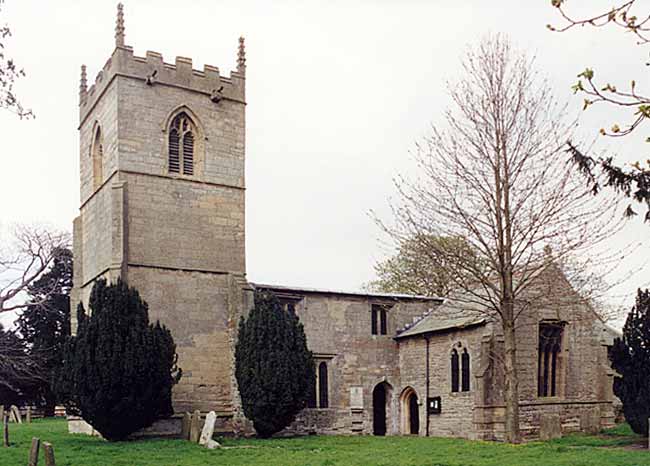 St Mary's, Egmanton, has a 15th century west
tower and a 12th century north arcade (© A P Nicholson, 2002).
St Mary's, Egmanton, has a 15th century west
tower and a 12th century north arcade (© A P Nicholson, 2002).The Church dedicated to St. Mary, is of great antiquity. The present vicar of this beautiful church is the Rev. F. Harvey. About ten years ago a restoration was carried out at the expense chiefly of the Duke of Newcastle, who rebuilt the chancel, and partly at that of the parishioners, who rebuilt the nave and aisle. The south door is of very plain Norman character, having an arched head of two orders, quite devoid of mouldings, in which respect it bears resemblance to the chapel in the White Tower of London. Immediately inside is a good specimen of an old oak poor-box, beyond which is a stone font of a tapering cone shape, quite without ornament, corresponding in date to the doorway, adjudged to be not later than 1075-1100. Of this font a good illustration is given from a photograph, taken at the time by Mr. L. Flore. The door and font are the sole remains of the Norman church. An arcade of four early English arches divides the nave from the aisle, and the chancel arch is of the same period. The rood screen has been replaced, and the organ pipes now occupy a space over the south door. In the chancel is a double-arched piscina, with a centre shaft, but only one drain; on the floor of the other compartment is incised a small cross, possibly a consecration cross. Inside the altar rails is a floor-stone to Nicholas Poutrell, a sergeant-at-law, on which are his arms, impaling those of two wives, the second of these bearings, being “or, three eagles displayed purpure,” and belonging to that of Anna, daughter of Sir Walter Rodney. Nicholas1 Poutrell (temp. Elizabeth) purchased Egmanton Hall and gave it to his cousin, Thomas Markham, of Ollerton. The property eventually passed into the possession of the Honourable Francis Pierrepont, and is now owned by the Duke of Newcastle.
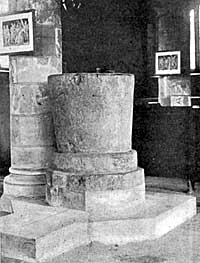
Font in Egmanton church.
Egmanton manor figures in the Domesday survey as being held in demesne by the great Roger de Busli, of Tickhill, whose work may be traced in the south-west part of the church. This influential man fought at the Battle of Hastings, under the Conqueror. He probably derived his name from Builli or Busli, near Rouen, and this seems to be substantiated by the appointment of the Prior of Blyth having been vested in the Abbot of Holy Trinity, Rouen, and forty shillings having been paid yearly by the monks of Blyth to that church. To Roger de Busli, William I. made very extensive grants of land, in fact, he owned nearly the whole of the north of the county of Notts., and his estates overflowed into Yorkshire and Derbyshire. He selected Tickhill, not far distant from Egmanton, for the site of his castle, and bestowed thence great favours to his followers, to the disadvantage of the original owners, whom these Norman intruders ejected. The family seems to have died out about the year 1102.
The reason of this manor of Egmanton being retained by Roger de Busli, in his own hands, is apparent when the great military mound, which dominates the village, is taken into consideration.
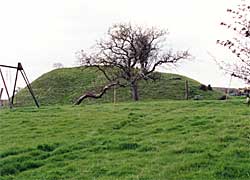
The motte and bailey castle at Egmanton is one of the best preserved in Nottinghamshire: the mound is over 20ft high and it measures 460ft in circumference (© A P Nicholson, 2002).
The interest attaching to this place (Egmanton) does not cease with Roger de Busli, for in the time of King Henry I., there were two brothers of the King’s family or Court, “stout men,” viz., the Earl of Clare and the Earl of Arundell. They had a third brother, one Nigellus de Albanci, who carried the King’s bow. For his merits he was made knight and enfeoffed by the king, of Egmanton, “with its parks and appurtenances.” It appears that shortly afterwards Nigellus made over this “town” to his great friend, Robert de Aiville, for which transaction he had to give account to the royal donor. The mother of Nigellus was a Mowbray. There is much more concerning the history of Egmanton in “Dr. Thoroton’s History,” but the occurrence of the name of D’Aiville may account for the arms of that family having appeared at one time in the neighbouring church of Laxton, where also, in the south-west window Thoroton records, “Gules, a lion rampant argent with a file of three labels,” with the remark “it should have been varry or chequey,” which arms he attributes to Everingham. But in “Burke’s Armoury” it states that “The Mowbrays descended from Roger de Mowbray, son of Nigel de Albini, who assumed that surname by command of Henry 1., &c,, &c.” The arms of these Mowbrays follow as “Gules, a lion rampant argent,” so that it is quite as possible that the arms were those of some eldest son of the family of Mowbray, with his mark of cadency, as those of Everingham, for Dr. Thoroton admits that “the colours are decayed.”
(1) The name of Poutrell is more closely identified with the neighbourhood of Thrumpton, in the Rushcliffe Hundred of Nottinghamshire, where eight generations had resided previously to the reign of Henry V., and under which place Dr. Thoroton sets out their pedigree. From this it may be seen that Nicholas (of Egmanton) was younger brother to Thomas Poutrell, and married Anna Rodney, but died without issue. They must have been a family of some importance, for the name carries no less than twenty-two references in the index of “Thoroton’s History.” The family arms, viz., argent, a fesse between three cinquefoils gules, appear in the chancel of Attenborough Church. The family is now extinct, but people of the name of Powdrill live in Gotham in the present day, who may be descendents, with the name corrupted.