
Oxton and its church
By the Rev. W. Laycock.
Oxton is stated to have been an ancient British burial place. Within its parish boundaries are to be found three, if not four, ancient camps, and three tumuli. One of the camps is acknowledged to be British, and in a good state of preservation.
Its church is most interesting, being more complete than most village churches, and possessing a chancel, nave, two aisles, with north and south arcades, and a tower. The south chancel wall with its doorway and three windows and chancel arch are held to be late Saxon work. A prebendary and rector of Oxton, in answering questions instituted by Henry VIII., stated that the prebend of Oxton was founded by Zeeb and King Edgar. It is supposed that Zeeb was King Edwy. If this be so then it would be before 958 A.D. If the prebend was founded then, it is a reasonable supposition to say that the church would be built about that date. In the new north wall the old Saxon doorway has been rebuilt.
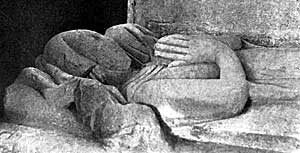
Effigy, Oxton church.
Evidently once a Saxon tower completed the design of the old church. All this goes to show that originally a complete Saxon church stood on this site. The fact of there being no west door, but a north and south door, strongly confirms the above statement. The small doorway in the tower and the restored buttresses in the north wall will date back to 1250. The north and east windows in the chancel, the tower with its window, and the two arcades will date back to about 1325. Of the two arcades no pillar is perpendicular, and no arch is in plumb line, whilst the circumference of the north pillars differs from that of the south pillars. The first arch of the south arcade stands out from the east wall, whilst the corresponding one on the north arcade does not. At the west end the south arcade terminates with a half Gothic arch, whilst the north arcade terminates with half-round arch appearing like a Saxon or Norman arch.
The old font of Oxton Church has, until recently, been doing duty as a pump trough. Twenty-four years ago it was sold from the vicarage garden. It is octagonal, in a rough state, with no sign whatever of any inscription or carving on it. It is of the same character as the Lutterworth old Wycliffe Font now in Leicester Museum. Its age may be from 650 to 700 years. It is now in the church resting on stones equally as old as itself, and which have been, none can tell for how long, in the vicarage grounds. Doubts are raised as to these stones forming the original base. Of one stone, however, there is no doubt whatever. It plainly carries with it its own evidence.
This venerable font may have been cast out in Cromwell's day, The present font is of the Charles II. pattern and period. From its decayed condition, as described in 1842, one can realize this statement to be correct. In the tower for many years back has been an oak chest, called the deed chest. Tradition credited it with being the old communion table, and such it has turned out to be. The paint has been scraped off, and the sides and bottom knocked out, with the result that there stands a solid oak table, dating back to Cromwell's day, if not indeed to Elizabeth's time. This venerable table has found a resting place in the vestry.
In the church, near the tower, lies a stone effigy in a good state of preservation. Two small angels with their wings form a canopy for the head, while the feet rest on a dog. The face and arms resemble those of a woman. Local tradition says it is the Virgin Mary, who rises up to pray when the clock strikes. The attitude is one of prayer. A closer inspection will disclose a short beard. One noted antiquarian declares it is a civilian, whilst another asserts it to be a lawyer. The latter is most probably correct. The cap with curls (note the knot under the chin) is the legal cap of Serjeants-at-law, called the coif. Evidently it is in memory of such, or of a renegade clergyman, who defied the canon by pleading in court, and put on the coif in order to hide the tonsure. The inscription is in Norman French, but is now completely obliterated. In Thoroton's History of Nottinghamshire, Throsby's Edition of 1790, the date given is 1126, though with much doubt. Other authorities say about 1280 is much more likely to be the date. This effigy was once buried, probably in Cromwell's day. It rose again before 1730[?].
The escutcheons or achievements or hatchments, no doubt, will refer to members of the Sherbrooke family. By the design can be known if those commemorated, at death, were married or un-married, widows or widowers.
The old registers go back to 1562, most of them being in good condition.
Two, if not three, of the four bells date from 1638.
" We pray for this our parish,"
" Thy mercy to implore;"
"On Church, and homes, and people,"
"O Lord, Thy blessing pour." S.P.C.K.
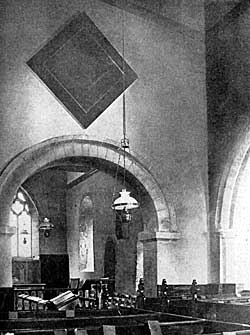
Interior of Oxton Church.
After the vicar had spoken as above about his church, the Rev A. Du Boulay Hill said he did not think the evidence of Saxon work in Oxton church could be sustained by anything now visible. The chancel arch was the work of the end of the 11th or beginning of the 12th century, and the very interesting south wall of the chancel, with one original window in it, the small one in the middle, might very well be of the same period.
The priest's door and the window to the east of it were undoubtedly 13th century insertions. Further evidence of date might be gained if the ivy outside the wall were removed, and it was a pity that no record had been made of the structure of the wall when the plaster was removed ten years ago.
The western tower was not part of the plan of the 14th century arcaded nave, having been built later, within the western end of the nave, owing to the limited space between the church and the roadway.
The stone effigy shows clearly the coif of a serjeant-at-law. I do not think there is any real proof of a coif worn to conceal a priest's tonsure. The date is not later than the beginning of the 14th century. Part of the inscription, in Norman French, is
LE • SOTERA DEV + DESALME MCI —
Throsby seems to have mistaken the " Deu de sa alme eyt merci," which is given here in a contracted form, as supplying a date.
After luncheon at the " Green Dragon," many of the members walked over to the Oldox camp ; a few of the ladies even venturing on the journey, in spite of a good deal of long wet hay-grass that had to be walked through. Mr. T. Davies Pryce has forwarded the following account of the earthwork, together with a plan of the site drawn to scale.