
Woodborough Church
By Mr. H. Gill.
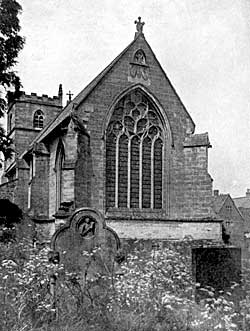
Woodborough church.
A former vicar of Woodborough, the Rev. Walter E. Buckland, M.A., has written a very complete history of this parish, therefore it will only be necessary on this occasion to direct attention to the chief features of interest in connection with this beautiful church.
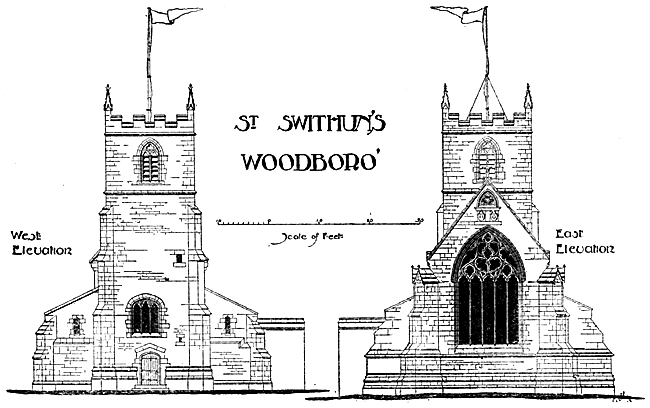
The east end claims special attention, on account of its noble proportions and the superiority of the design and workmanship. It differs from the type generally found in this county, and it is undoubtedly the work of a peripatetic school of craftsmen, who built or enlarged several churches in this district, of which St. Andrew's, Heckington, Lincs. (1320-1380) is the crowning glory. So far as I have been able to trace it, their work in this county commenced with the famous chapter house at Southwell (1285-1300). Newark was the next place to receive attention, where, apparently, they intended to rebuild the whole church, but the upper stages of the tower, the spire, and the south aisle are the only portions that were completed (1313-1350). At the same time Hawton (1330) and Sibthorp appear to have been in hand; also the rood screen in Southwell Minster (1330-1340) and the chancel at Arnold. Then for a brief period all building operations were suspended on account of the "black death" (1349). The chancels at Woodborough (1356), Car Colston (1360), and Epperstone complete the list, but the latter has been pulled down and entirely destroyed. It is interesting to notice that the Easter sepulchre is to be found in nearly all the chancels built by this school of craftsmen before the “black death,” and not in any that were built after that terrible visitation. This seems to indicate that the school was decimated, but not entirely disbanded.
Woodborough was one of the prebendal churches in the Peculiar of Southwell, and we should therefore expect to find that the builder of the chancel was an ecclesiastic; but it was not so. It is general knowledge that the prebendaries of the time were pluralists—lazy and indifferent—caring as little for the church buildings as they did for the people who were committed to their charge, so that when the manor of Woodborough was presented to young Richard de Strelley by his great-uncle, Paganus de Vilers, the little Norman church was perhaps found to be in such a neglected condition, that it became necessary for him to rebuild it.
We were told when visiting Strelley, two years ago, that Sampson de Strelley, the father of Richard, rebuilt the church at Strelley in 1356, and it is not at all unlikely that father and son were engaged in the work of church restoration in their, respective parishes at the same time, for we know from documents that Richard de Strelley came into possession of the manor of Woodborough in 1336, and he held it until 1358, when he was succeeded by his youngest son, Thomas.
But even supposing that no documentary evidence was forthcoming, the fragments of heraldry that still remain would justify us in attributing the work to the Strelleys, and the style of the architecture determines the date of the rebuilding to be the middle period of the 14th century.
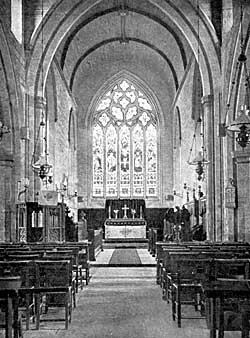 Interior, Woodborough church.
In confirmation of this statement, look at the design of the chancel windows; see how naturally and gracefully the tracery is made to spring from the mullions without any break in the sweep of the lines. This indicates the Curvilinear or Sowing period of the Decorated style (1315-1360), so called to distinguish it from the earlier or Geometrical period. The design of the great east window of five lights, although somewhat weak in places, is nevertheless a fine specimen of the style, while the three-light windows at the sides are perfect examples of “tangent circle” or “reticulated” tracery.
It was at this time that painted glass had reached its highest perfection, and we can understand how the glass-man would delight in filling such elegant spaces with his designs. But alas! the ancient glass has nearly all disappeared, and we can only judge of its effect by the few scattered fragments that remain and by the descriptions given by those who saw it many years ago.
Thoroton visited the church in 1670, and he has given an account of all the blazons, and these include the oft-recurring arms of the Strelleys and their alliances.
One hundred years later Throsby wrote:—“The chancel windows were once rich with painted glass, but now they are so filthy, broken and patched that little can be made out to please by description.”
William Stretton, who visited the church in 1818, says: “The whole of the windows were, not more than 20 or 30 years since, most beautifully adorned with painted glass in a high state of preservation, but great part of them are now glazed with common glass, and the painted lies in an old chest for any one to carry away who chooses.”
The fragments remaining are :—
A six-winged seraph in the quatrefoil on the south side of the east window.
St. Margaret with a cross in her hand and a dragon under her feet, and St. Catherine, with a wheel and a knife, in the south-east window of chancel. These two saints, the most popular in mediaeval art, are found in all the churches built by this school or guild.
On the north side, beginning from the east end:—
1.—Figure subject, difficult to determine, probably patchwork.
2.—“Christ in the Garden” (with beautiful diapered background).
3.—“Touch me not, I am not yet ascended.”
4.—“Doubting Thomas,” and fragments of heraldry.
“Nothing probably has done so much to destroy the sense of colour, once so exquisite in England, as this wanton destruction of the painted windows and frescoed walls of our churches.”— Wakeman.
Notice also the beautiful stone carvings. The small sculptured stops to the hood-mould inside the east window, being so far above the level of the eye, are liable to be overlooked, but they are worthy of careful inspection.
The sculptured figures supporting the statue brackets, on either side of the east window, are intended to represent the reigning sovereign, King Edward III. (north side) and his Queen Phillipa (south side), 1327-1377, and similar carvings form the stops to the hood-mould outside the east window. Indeed, they may be found again and again in all the churches that were built at this period, and especially in the churches built by this particular school of workmen, but I think that the carvings at Woodborough, owing, perhaps, to the fine grain of the stone and the freedom from mutilation, are the most beautiful of them all.