
Church of St. Peter and St. Paul, Sturton-le-Steeple.
BY THE REV. GEORGE F. TWYCROSS.
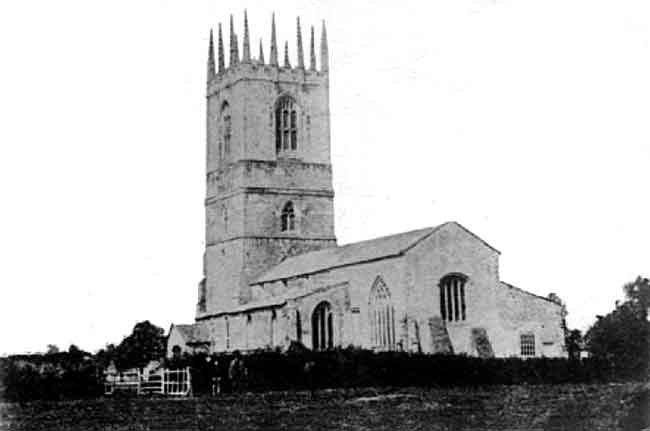
Sturton-le-Steeple (prior to the fire). From an old print.
The story of the church commences with the Norman fragments built into the wall of the vestry. These were discovered, embedded in the masonry above the north nave arcade at the time of the restoration of the building, by Mr. Hodgson Fowler, after the fire of 1901. It has been suggested that the marks of fire upon them afford evidence of a disaster in early times, similar to that of eight years ago, and that the entire disappearance of the original Norman church might be thus accounted for. Some of these fragments may have formed part of a chancel arch. Some are clearly the remains of a doorway three feet wide, which must have been of a fairly ornate character, as we have both chevron moulding and beakheads represented. They belong to the first half of the 12th century. Of the original Norman church we can say very little. Since it was entirely removed to make room for a larger building, it may have resembled in plan the small neighbouring churches of Littleborough and South Wheatley.
The earliest portions of the church, as it stands, are to be found in the north wall of the chancel. Writers on ecclesiology constantly insist on the great importance of the ground plan in ascertaining the date of a church. Let us see what we have here. There is a long chancel, without a chancel arch, the walls being in a line with the nave arcades. The nave was originally longer than at present, the western bay on the north side having been sacrificed when the tower was erected in the 14th century. The absence of the chancel arch is not uncommon in this district, as may be seen at Saundby, South Leverton, Cottam, and Babworth. Mr. Bond, in his recent work on Gothic Architecture, mentions this as a characteristic of a chapel plan as distinct from that of a parish church. This holds good of Cottam, but does not apply here or at South Leverton. The old church of St. Nicholas, Hedon, was similar in plan to Sturton, as regards the absence of chancel arch and continuous line of nave and chance! walls. On these grounds Mr. Boyle in his Early History of Hedon, assigns it to the late Norman or Transition period. Mr. Hodgson Fowler thinks the rebuilding of our church took place about 1180. The work he assigns to this date was fortunately uninjured by the fire. It includes the wide doorway on the north side of the chancel, which probably led to a sacristy, and a round-headed window, further east, built high up in the wall. The position of this window may be due to the sacristy extending to the east end of the church. In any case we have mediaeval cautiousness to fall back upon as an explanation. Chancel windows on the north side, if constructed at all in village churches, must be sufficiently high to prevent the "Evil One" from looking in upon the altar.
Mr. Fowler thinks the Norman nave was rebuilt at the close of the 12th century with a north aisle, the arcade being in appearance exactly as at the present time. The old work has been most faithfully copied, and stones replaced wherever possible. I have already mentioned that the north arcade originally consisted of four bays. After the fire the west respond was discovered walled in by the substantial masonry of the tower. The present respond, to quote Mr. Fowler's words, "is really a complete pier with the western wall built half round it. This had saved the western side of the capital from the recutting which took place at a much later date. During the restoration this cap was turned round so as to show the original work."
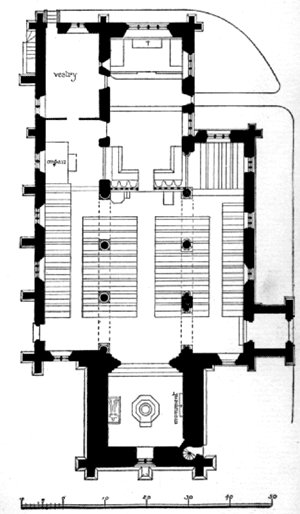
SS Peter & Paul, Sturton-le-Steeple.
The bases on the north side are of Transitional type, with the water-hollow
between two rolls, Mr. Bond mentions that the lower roll was not at first
of semicircular section. It had the appearance of being crushed by the
weight of the superincumbent column. He dates this feature circa 1155
to 1190. Again he mentions that during the same period the water leaf
was used as a spur at the base. As both these features occur here, we
shall probably be right in assigning the original north arcade to about
the year 1190. The round-headed doorways of the nave are of the same
date. That on the north side would be placed in the outer wall of a narrow
aisle. That on the south side would probably be opposite, as now, but
in the wall which occupied the position of the present south arcade.
The capitals of this doorway exhibit the small volute curling inward
instead of outward. As this is stated only to occur from 1165 to 1190,
it forms another valuable criterion of date. The arch-moulding exhibits
the keeled as well as the earlier cylindrical edge-roll.
We can now form a very fair idea of the appearance of the church at the close
of the 12th century. Its essential features were a chancel 37ft. long, and
a nave 52ft. in length, both with a uniform breadth of 18ft., a narrow north
aisle and sacristy, two doorways, and possibly a wooden bell-turret on the
western gable.
There is considerable probability that we can identify the founder of this Transitional building. About 1180 there was living in the neighbourhood a wealthy lady, who must have taken a great interest in the church. This was Lady Oliva, the daughter of Alan Fitz Jordan, and Lady of the Manor of Oswaldbeck Soke. She was buried at Sturton as the chief place of the district, and her monument was discovered in 1870, placed face downward on the north side of the chancel.' It is now under the tower and bears the inscription: MATER - OPIS - VIVA - PER - TE - SALVETUR - OLIVA - According to the late Earl of Liverpool, Lady Oliva died soon after 1236.
Passing over a century, we reach the period of the erection of the south
aisle. It would be about 1300 that the 12th century wall would be gradually
removed, to be replaced by the south arcade. The remains of this period
are extremely scanty. We certainly have exact reproductions of the old
arcade, and can note the double capitals with the characteristic curve-and-slant
moulding. With the exception of the window at the east end of the aisle,
all the tracery of the windows is due to Ewan Christian, who restored
the church in 1870. The window I refer to was spared at that time, but
was unfortunately destroyed by the fire of 1901. It is late Geometrical
in design. Near it is a piscina with grooves for a shelf to hold the
sacred vessels.
The north wall of the church was entirely rebuilt in 1870. None of the original
tracery remained at that time, but it is extremely probable, as the present
modern windows suggest, that the north aisle was widened at the beginning of
the 14th century. To this period I should be inclined to assign the arched
opening, behind the pulpit, with its discontinuous imposts. Thus the alterations,
a century after the building of the church, include the addition of a south
aisle and the widening of the north aisle.
About 1340 or 1350 the first two stages of the tower were built at the expense, as we have already seen, of the western bay of the nave. The last column in the north arcade became a respond. What happened on the south side is not so easy to trace. I take it that the piece of walling in the south arcade, opposite the porch, is a fragment of the original outer wall of the 1180 church. The arch to the west of it was evidently rebuilt on a smaller scale when the tower was erected.
The curve and slant moulding still occurs in the capital, but the base bears the character of the Transition to Perpendicular.
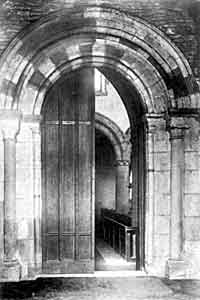
South door. Sturton-le-Steeple.
To return to the tower. With its massive walls, five feet in thickness, and great width and height, it is singularly out of proportion to the rest of the church. Indeed, the erection of the tower has so shortened the nave that its breadth exceeds its length by nine and a half feet In the west wall is a pointed window of two lights with Curvilinear tracery. Above this, in the second stage, are four similar windows, now glazed, but originally forming the belfry openings. The tower of 1350 terminated in a plain parapet, which can be clearly seen immediately below the clock. Other features of this date are the small doorways and the square-headed window in the chancel. There was also a magnificent window of five lights in the south wall of the chancel prior to the restoration of 1870. This may be seen in the one existing photograph of the church in its original condition. There the chancel walls are shown to be considerably higher than they are now. The effect would be a fine lofty sanctuary such as we have in the adjoining parish of North Leverton.
About 1480 the two upper stages of the tower were added. Mr. Fowler remarks that the parapet of 1350 exists as a band on the present tower. He adds that the masonry is uniform throughout, the same quarry being used and the traditional way of working. His remark respecting the masonry applies only to the exterior. Viewed from the interior there is a decided break in the masonry, the lower part being rag-work and the upper part sandstone rubble. The belfry windows are of the ordinary Rectilinear type of three lights, with a transom on which are miniature battlements, indicating a late date. The twelve pinnacles are a remarkable feature. They are in no sense constructive, being widely separated from the somewhat diminutive buttresses of the older 1350 tower. The tower contains five bells, all cast in 1826, a year well remembered by the vicar's warden, Mr. William Wilkinson, who was born in 1812, and is now in his 97th year.
One of the most grievous effects of the fire was the loss of the fine oak rood screen, of 15th century date, with its returned stalls and misericordes.
About 1520 a plain east window of four lights was inserted, together with the clerestory shown in the old photograph.
No alterations of any importance took place in the fabric until 1870. A singing-loft was erected by subscription in 1776. Here was used the pitch-pipe in the writer's possession, for many years the only "instrument of music" heard within the walls of the church.
I have already referred to the restoration by Ewan Christian in 1870. I will only add that he entirely rebuilt the north and east walls, took away the clerestory (stigmatised at the time as modern), and placed a high-pitched roof of uniform elevation upon the whole length of the building. In 1901 there was something more than restoration required. And yet so great was the care bestowed upon the work by Mr. Hodgson Fowler, that it is still possible to trace the life history of this church century by century, a history which, to the archaeologist, must possess a greater interest than that of many a building wearing a more venerable aspect.
In the Society's Transactions of 1903 the late Earl of Liverpool, then Lord Hawkesbury, half-brother to Mr. Foijambe, of Osberton, contributed a paper on the inscriptions on the tombs of the Thornhagh family in this church, in which volume all information on this subject can be found.
After three miles of featureless country were covered, Littleborough was reached, a more interesting place perhaps, than any other visited during the day. The party at once assembled on the bank of the Trent, at the spot where the now disused ferry once existed. It appears that a few years ago, a barge unfortunately rammed and sank the ferry-boat maintained by the lord of the manor. Neither the owners of the barge nor the lord of the manor (Mr. Foljambe, of Osberton) would refloat the wreck, and from that day this important crossing-place of the Trent has, as such, ceased to exist. Ensuing on this, the parishioners or some of them, suffered a further misfortune; for the cessation of the ferry traffic caused the adjoining village inn to close its doors.
Mr. T. Cecil Smith Woolley, of Collingham, here read a paper as follows.