North Wheatley
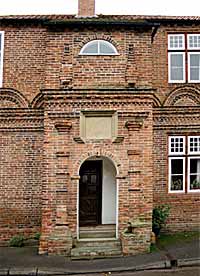
17th-century brick house in North Wheatley.
After quitting Clayworth and overcoming the difficulty of the well-named "Awkward Hill," the party passed through the village of North Wheatley, where the church is dedicated to SS. Peter and Paul. It was restored in 1894-6 under the supervision of Mr. Hodgson Fowler.
During the reign of Richard I. the rectory was given to the Archbishop of Rouen by John, then Earl of Mortam. Before long, however, it was taken back, and became a Crown possession. After passing through various hands it became the property of Sir Thomas Willoughby, Bart., of Wollaton (1710), and is still in the holding of Lord Middleton, his descendant. The church belongs almost entirely to the Perpendicular period. The Norman chancel was taken down in 1825 and the present one built. At the same date the fine rood screen was wantonly destroyed.'
Other features to be noticed are a large Norman tub font; a pulpit, dated 1604, and inscribed "Wo unto me except I preach the Gospel"; a rough stairway in the tower; old woodwork in the sittings, and a few brasses. It is worthy of note that there is a small stream on the south side of this parish, known as the Oswaldbeck, with which the original Oswaldbec Soke may be connected.
At the corner of the road, leading up the hill to the church, is a charming old brick-built house, bearing the date 1673 and a shield of the arms of the Cartwrights, of Wheatley, viz., argent, two chevronels between three lions rampant, gules.
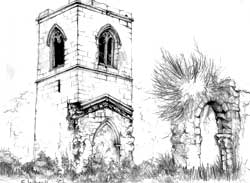
St Helen's church, South Wheatley, has been a ruin since 1883.
Some three-quarters of a mile further, on the left side of the road, stand the ruins of South Wheatley church; a plain Norman chancel arch and a Perpendicular tower are all that remain standing, and the bases of the arcade may still be seen. The font from this church is now in use in St. Catharine's, Nottingham. The church stands quite isolated, and was probably allowed to fall into decay, as not needed, North Wheatley church being only about half a mile distant.
The Archbishop of York was lord of the manor and patron of the church, which was probably built by Archbishop R. de Pont Evêque. The tenure of the manor continued in the hands of the Archbishop until 1545, when William Whorwood, Attorney General to King Henry VIII., claimed it for the king, together with other manors and estates in north Nottinghamshire. Robert Holgate was then Archbishop of York. The Markham family were also owners in this parish, but on the attainder of one of that family the land passed to others. (30 June, ii. Jac.).
After traversing five and a half miles without a stop, the village of
Sturton-le-Steeple was reached, the fine pinnacled tower of the church
of SS. Peter and Paul, to which feature can be attributed the latter
part of the name of the place, forming a conspicuous object in the landscape
for some distance.
This place was anciently known as Streton, being a village on the Roman road
to the north, and in later days as Sturton-in-the-Clay. The parish was enclosed
in 1823, when an allotment of 727a. 1r. 40p. was awarded to the dean and chapter
of York in lieu of rectorial tithes, and 127a. 3r. 8p. to the vicar in compensation
for the small tithes. The Right Hon. F. J. Savile Foijambe, of Osberton, is
lord of the manor and chief owner, the lordship having come into his family
by a marriage with a daughter of the Hewitt family, of Shireoaks.
A hamlet in this parish, named Fenton, was the home of a family which took its name from the place, and which boasts of two illustrious brothers, viz., Captain Robert Fenton, who was with Sir Martin Frobisher in one of his voyages of discovery in search of a north-west passage, and who also was distinguished at the time of the Armada (July, 1588), on which occasion he is said to have steered the admiral's ship. The other brother was Sir Geoffrey Fenton, an illustrious politician. Many pages of Brown's "Worthies and Celebrities of Nottinghamshire" are devoted to the careers of these two men.
The vicar (Rev. G. F. Twycross) read a detailed paper in the church, and evinced a lively interest in the visit of the Society.