
Some Nottinghamshire and Lincolnshire Easter Sepulchres
By Ernest Woolley, F.S.A.
The subject of Easter Sepulchres in England appears to be little known. I cannot claim to be more than a novice myself in it. I hope however, to make further research and in the meantime perhaps my present illustrations may incite others to do the same and to supplement this sketch.
In the Society of Antiquaries’ Archaeologia, of 12th March, 1868, Vol. XLII, page 263, there is an exhaustive account of the Ritual by Alfred Heales, F.S.A. from which much of the following is culled.
Shortly the original ceremony was, in Saxon times, the deposit, in a hollow place with a curtain or door, of the Cross, wrapped in a cloth, on Maundy Thursday, to be kept there until Easter Eve, when “two or more Bretheren remove it singing Psalms.”
In subsequent times three Hosts were consecrated on Maundy Thursday according to the Sarum use, which was the practice most likely to have been followed throughout England and Scotland with some slight variations of ritual. The Office of Rome prescribed two Hosts, which was apparently the custom on the continent of Europe. One Host was then deposited, with the Cross, in the Easter Sepulchre. These were restored to the Altar on Good Friday when, after the Mass of the pre-sanctified, followed by Vespers, they were returned to the Easter Sepulchre, which was thereupon watched with lighted candles until Easter morning. On that day, before Mass and before the ringing of the bells, the Host was carried back to the Altar. “Then they take the Cross out of the Sepulchre and the chief of them begins Christus resurgens and they proceed in procession to the Presbytery,” and the Cross is put once again in its usual place. In the Hereford use, before deposit in the sepulchre, the Cross was laid down before the door and washed with wine and water and then covered with a linen cloth.
This Easter Sepulchre custom was kept up until after the Reformation, as appears by the Visitation Articles of Archbishop Cranmer, 2 Edward VI.
The Easter Sepulchre itself was usually in the north wall of the presbytery, or sanctuary, near the Altar.
Heales enumerates a good many such instances and a few in the south or east wall. In numerous cases a Founder’s Tomb was used for this purpose such as that at Irnham.
There was evidently some temporary erection, to supplement either the fixed sepulchre, or Founder’s tomb, in the shape of a removable frame work of wood, covered in with decorated hangings, after the fashion of a Tabernacle. No instance appears to be extant but I gather that there is some evidence of them in accounts and inventories of Parish properties. Heales quotes Leverton, Lincolnshire, 1555—
Making of sepulkkure Howysse jjjd. For paynting a clothe for the saym ijs. For feycheying of the Sepulkcure clothe from the Paynts att Boston ijd.
It is noteworthy that in 1484 Sir Charles Pilkington leaves for the repairing of the Sepulchre at Worksop five Marks.
As regards the fine streak of Easter Sepulchres, running in an irregular line from Lincoln, through Navenby, Heckington, Irnham, Lincs., and Hawton, Sibthorpe and Arnold, Notts., they all seem to reflect the influence of the same school or band of Masons.
Whether that influence came from Lincoln or York I am not competent to settle, but, in the absence of material evidence to the contrary, I hold the Lincoln view, and in that I am supported by a friend whose knowledge is, I believe, trustworthy. They all date in the first half of the 14th century, and, except Lincoln and Irnham, are on the north wall of the presbytery or sanctuary.
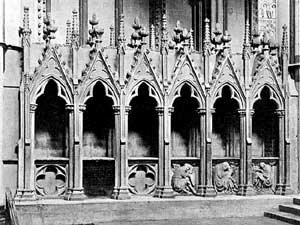
Easter Sepulchre, Lincoln Cathedral.
Heales remarks that the superstructure of that in Lincoln Cathedral has been destroyed. There is no trace of anything to show that there ever was such a superstructure.
In “Armour of England,” J. Starkie Gardner, 1897, there is a picture of the sleeping soldiers restored. I trust that it may be a prophecy unfulfilled if prophecy it is.
There can be few finer instances than this specimen in the presbytery at Lincoln of an Easter Sepulchre, though some of the others are more complete in representations of the events following the Crucifixion and Burial.
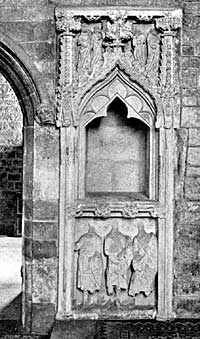
Easter Sepulchre, Navenby, Lincs.
That at Navenby has a charming simplicity about it. The Soldiers are not sleeping apparently, but stand upright. Above them is the Sepulchre: on either side of the finial above, stand an angel and one of the two women at the tomb.
In the Heckington illustration I omit the four sleeping soldiers because they are so much damaged. Their pose, though, indicates what the excellence of their sculpture must have been. The two women and angels are on either side of the Sepulchre, and over it Christ stands fully clothed, and the scene is therefore, I suppose, preparatory to the Ascension, and is flanked by angels which probably were censing.
The sculpture in the cornice is similar in character to that above the Compton Tomb and north door next to the Easter Sepulchre at Hawton.
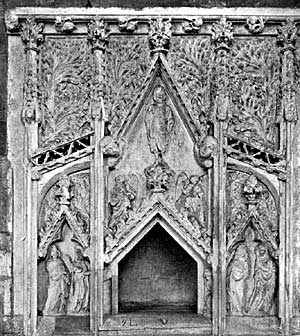
Easter Sepulchre, Heckington , Lincs (top part).