
< Previous | Contents | Next >
London Road
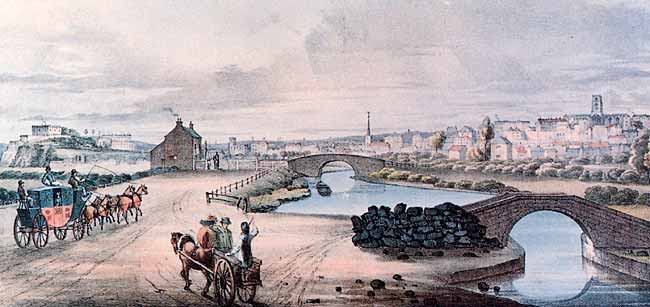 Nottingham from London Road, c.1808.
It is difficult to realise as one walks down the modern London Road with its wilderness of brick and mortar that less than two hundred years it was one of the favourite promenades of the good folk of Nottingham. And even more difficult is it to understand that it was an ipse dixit amongst travellers by stage coaches that the mile that separated Trent Bridge from Nottingham was the most beautiful mile near any town in Great Britain. But it must have been beautiful. The road crossed a lovely open space, the common lands of the town which in spring were carpeted with the etherial blue of the crocus that we have now destroyed. On the western side of the road was the West Croft between the Tinker's Leen and the Canal. It was commonable for the burgesses from July 6th to August 13th and again from October 3rd to Old Candlemass. Each burgess had a right to turn three head of cattle or forty-five sheep into the common fields during these periods. On the eastern side was the canal and then the East Croft. The East Croft was also commonable, but a small fee was charged for the accommodation of cattle and out of the common land was reserved a small holding of some three acres which in addition to the fees, provided a salary for a Pinder and a Fieldpinder. Of these officials the names of "Pinders House Road" off Crocus Street and "Pinders Street" off Poplar Street are the only reminders.
During its progress across this open country the road had to make its way round two great pools. Chainey Pool was the largest and was situated nearest to the Trent. It was about opposite the end of Crocus Street and it was celebrated for its stock of fish. A hundred yards nearer to the town was the second pool Chainey Flash which probably got its name of "flash" from the old custom of "flashing" boats through a weir and may represent a sudden deepening in some lost streamlet. Long ago these two pools were crossed by wooden bridges, but traffic was only permitted across these wooden bridges when the river was in flood and in normal times they were stopped up by a great chain fastened across them hence their name "Chainey" or "Chain." The road also had to cross the Tinker's Leen, which still flows, and is a southern branch of the river Leen. Finally just before getting to the end of Narrow Marsh the road had to get across the many branches and the swamps of the river Leen itself.
The history of the road is rather difficult to make out. It is of immemorial antiquity being the successor to the primitive track across the marshes of the Trent Valley. About 1766 the wooden bridges to which I have referred were replaced by stone structures which were kept permanently open and these stone bridges were replaced by a bridge of ten arches which was erected in 1790. However, it had hardly got up when there came a terrible flood, one of the worst ever known, for in 1795 it so badly damaged the bridge as to render it quite unsafe, and it was decided to pull it down. The situation was complicated by the number of people who were responsible for the upkeep of the bridge. It appears that almost each arch was assigned to the custody of some Hundred or Weapontake and the disputes as to who was responsible were endless. Nottingham's share was the two northern arches and part of the crown between the second and third arches. Altogether there were twenty-three arches and this joint responsibility caused endless bickering and disputes in the course of which the bridge became entirely unsafe and positively dangerous.
But a fresh power was arising in the land. Coaching traffic was developing and in order to provide for its accommodation, roads were being improved out of all recognition, and one of the greatest forces in this improvement was the establishment of turnpikes. In theory the turnpike system is thoroughly sensible and simple. It was felt that those who benefited by the improved roads should pay for them, and so Trusts were formed by Acts of Parliament which were authorised to construct new roads or to improve ancient roads and to levy toll upon all wayfarers using these roads, the Trusts using these tolls for the upkeep of the roads, Of course this led to a great deal of hardship, for it prevented impecunious people from using roads at all and it led to untold difficulty for the drovers who were bringing the huge herds of cattle down from Scotland to be pastured in the fat Midland grazing lands previous to slaughter, but these difficulties gradually adjusted themselves, and the echo of this adjustment is to be found in the mysterious Drift Roads, which are such a joy to follow in these days of hurry and bustle.
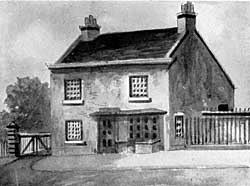
Toll house, London Road.
Anyway, in 1796 an Act of Parliament was passed establishing a Turnpike Trust with jurisdiction over the road from the north side of Trent Bridge to the west of St. Mary's Church. This road was constructed a little to the east of the ancient road and bridge, which had an interesting effect as we shall see when we come to Plumtree Square. Eventually the hedge between it and the old road was thrown down and the two were amalgamated into one which accounts for the magnificent and welcome width of the modern London Road. It crossed the Meadows upon many arches which permitted the flood water to get away and of which arches some traces remain even now. To collect toll on this road a bar was placed about opposite the end of Trent Lane. There is no trace whatever of this nowadays, and I do not know when it was done away with, but it is shown on the map of 1860.
The canal was of enormous benefit to our forefathers. The bill for its construction received the Royal Assent in 1783, but that was a period of great financial stringency and nothing was done until 1792 when the first sod was cut. When a start was made, work proceeded apace, and by the following year, 1793, the first section of the canal was ready for opening. It extended from the river Trent to the town somewhere about Poplar. The opening of this canal was an occasion of much ceremony, a procession of three decorated barges was formed, each barge being loaded with stone. In the first barge was placed the engineer of the work and he was accompanied by the regimental band of the Light Horse then in garrison at the Park Barracks. As the first lock was filled these heroes played "Rule Britannia" and during the voyage to the town they played "Hearts of Oak," "God Save the King," and other similar patriotic but singularly unappropriate nautical pieces.