< Previous | Contents | Next >
Castle Gate and Stanford Street
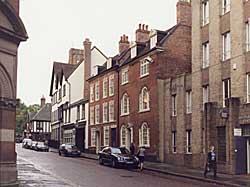 Early Georgian and modern buildings on Castle
Gate (A Nicholson, 2001).
Early Georgian and modern buildings on Castle
Gate (A Nicholson, 2001).Returning to the foot of Low Pavement we find ourselves face to face with Castle Gate the most beautiful and dignified street in the whole city. Its splendid Georgian houses with their beautiful details and exquisite brickwork, the historical associations of many of its houses and above all the great balloon of the chestnut tree which peeps out from St. Nicholas Churchyard render it a perfect delight to walk up. It is not a very old street, as streets go in Nottingham, and is first mentioned in 1315. Its early name was French Gate which shows it to have been constructed in connection with the new town formed soon after the Conquest for the French followers of Peveril. There is a tradition that Ralph Bugge lived somewhere in Castle Gate before settling in St. Mary's Gate, but the site of his residence is lost, if it be true that he lived in this street.
As we are now in the heart of the fashionable quarter of the 18th century of Nottingham a few notes about 18th century houses in general may not be out of place. To begin with the kitchen and servants' quarters and so forth were almost invariably placed in the basement while the servants' sleeping quarters were in the attics. Very often an open area was left between the house and the street which area was excavated and let light and air into the basement. Although such areas are very general in London there are few, if any, examples remaining in Nottingham. But the houses were generally set back a few feet and divided from the roadway by means of iron palisades of which various examples still remain in our midst. Great attention was paid to the doorways which were generally very narrow and a good deal higher than our more modern doorways and were enriched by fan-lights. Under the influence of the work of the brothers Adam very beautiful classic decoration was introduced into the jambs and lintels of these doors and almost invariably a projecting hood was provided to act as a defence against the weather. These hoods were carried on consols which gave opportunity for the display of much enrichment. They were often of wood, sometimes of stone, and in Castle Gate one remains made of wrought iron. The doors themselves and their fittings are of great interest. From the Restoration to Queen Anne they were usually framed in four panels, but by Georgian days six panel doors that is two panels wide and three high had come into fashion. The hinges were at first large and L shaped, but by degrees they became secret. The door knobs and knockers were objects of great attention, some of the latter being of great beauty. Often they take the form of a hand, or of a closed hand holding a wreath and this form has rather an interesting origin being eastern in its provenance and representing the hand of Allah protecting the house. Nottingham is also noticeable for a number of the beautiful Juno-Head knockers which gradually, by the middle of the 19th century emerged into a portrait of Queen Alexandra. The windows also are interesting. The old type of window which was used right down to Stuart times was a casement opening like a door and glazed with small panes of glass. The sash came into use, probably from the Low Countries, by the time of Charles I. but it was not generally used until William and Mary were on the throne, by which time its convenience had been thoroughly appreciated and many of the windows in the more important rooms were changed from the old casement into sashes. The panes of glass in these sashes were much larger than those used for the ancient casements, but the glazing bars were heavy and thick and made of wood and interfered a good deal with the passage of light.
A very charming type of window was the Venetian Window of which there is an excellent example on the first floor of the house at the corner of Stanford Street and Castle Gate. It consists of grouping three square headed windows together and surmounting the group by an enlarged fan-light. In this combination it is interesting to observe the return to the older Gothic methods, for it was by grouping 13th century Lancet windows together and binding them into one whole by means of a hood-moulding that all the wonderful Decorated and Perpendicular tracery of the later Gothic windows was developed.
Castle Gate Chapel has been called the "Nonconformist Cathedral of the Midlands" and its history is extremely interesting. It stands upon the site of the first Nonconformist Chapel built in Nottingham. It was not an impressive building being a galleried structure roughly square of about fifty feet each way. It was opened on May 29th, 1689, and had a graveyard attached to it, and seems to have entered upon its career by doing very useful work. In the middle of the 18th century the congregation at High Pavement adopted certain theological views which did not meet with the approval of a considerable portion of the congregation who seceded and joined the congregation worshipping in Castle Gate, leading of course to a considerable augmentation of their members. The present Chapel was built in 1863 from the designs of Mr. Sutton, and the schoolrooms attached to it are singularly complete.
Somewhere about here there used to run a brook in ancient days called the Rowell. It seems to have taken its rise in the high ground about where Park Street now stands and to have trickled down the slope and eventually found its way into the Leen. It was a bit of a nuisance to our forefathers and we are constantly coming across references to it and to its misdemeanours in the Borough Records and I have often wondered whether that marshy place in Truswell's Yard whose pavement never seems to remain in a satisfactory condition for very long is not a modern descendant of this brook.
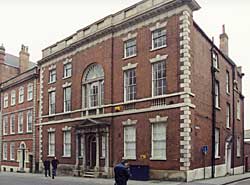
Stanford House on Castle Gate was built soon after 1775 (A Nicholson, 2001).
Stanford Street on the south side of Castle Gate is quite a modern thoroughfare and was not formed until 1853. In certain old documents and maps it is referred to as Stamford Street, but it really gets its name from a certain Mr. Stanford, a wealthy silk merchant who lived at its corner. This gentleman was an extreme Royalist and in 1789 when George III. recovered from his mental malady and the town was illuminated Mr. Stanford's house was noticeable for the gorgeousness of its decorations, and further than this Mr. Stanford gave half a hogshead of ale to the neighbouring populace in which to drink the King's health. His house still stands and is one of the most magnificent houses in the whole of Nottingham, but its history goes back much further than Mr. Stanford's time for it was the town house of the celebrated family of Howe of Langar of which notable family the most prominent member was Richard, Admiral Howe, who, on June 1st, 1794 gained the great victory over the French fleet off Brest which victory we celebrate under the name of "The Glorious First of June."
The exact date of the erection of this wonderful house I cannot tell, but apparently it was sometime about 1775, and its details both inside and out are beautiful in the extreme. We have already noticed the Venetian Window over the portal; it is quite the finest in the town, but the portal itself is well worthy of attention. It consists of four pilasters crowned by curious capitals of a type very much used by the school of the brothers Adam. These pilasters support an architrave and over the entrance is a very curious stuccoed enrichment formed out of an ox's skull and two swags of drapery and flowers. This enrichment is an imitation of the decoration of the altars of Greek and Roman times, for after a sacrifice had been offered the skull of the victim was hanged upon the corner of the altar together with the garlands and ribbons which had decorated it when led to the altar, as a sort of tally to show the popularity of the god. It will be noticed that instead of the parapet which surrounds the leads at Willoughby House and other similar residences Lord Howe's house is materially lightened by pleasant balustrades round its edge which answer the same purpose, but are far more decorative than the solid parapets that we have already noticed.