
< Previous | Contents | Next >
An itinerary of Nottingham
Nottingham Castle
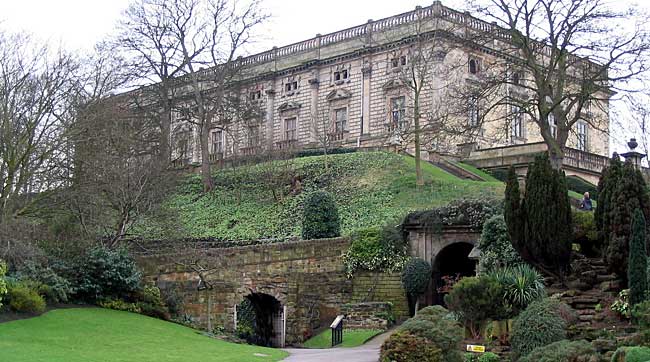
The 17th century Ducal Palace of the Duke of Newcastle at Nottingham Castle (A Nicholson, 2004).
JUST as when we were considering St. Mary's Church we found that so much had already been written about its history and interest that the merest sketch of its story was all that was necessary to include in these notes, so it is with Nottingham Castle, for the work of Mr. T. C. Hine and Mr. H. Gill and others supply a wealth of detail and information for the student. All that it is necessary to do here is to give an outline of the fascinating story of the ancient site and to attempt to give a few pointers as to its development into its present condition.
It is uncertain whether there was a primeval fortress upon the Castle Cliff, but the commanding situation seems to be too powerful for it to have been overlooked. If there were such a fortress all trace of it has long since vanished. A "Strong Tower" is mentioned in Nottingham in the 8th century and no doubt that might be situate upon the cliff. Whatever fortifications may have occupied the site before the Conquest they would be communal in their character, meant as a defence to the neighbourhood and not true castles which were a refuge for an invading force and its commander in the midst of a hostile country.
The first real date in the history of Nottingham Castle is 1068, in which year William Peveril was placed in charge of the newly-erected castle, which we are told was built "in a style that was hitherto unknown." What this castle was like we do not know. As the site was merely rock it would be impossible to throw up the usual Mound and Bailey Castle and I think it was probably a wooden palisade with lean-to buildings against its inner face. At any rate there is nothing whatever left of this castle.
During the tumultuous reign of King Stephen, Nottingham Castle was held for the King by Peveril, son of the original governor of William the Conqueror's time, and he defeated an attack upon him delivered by Matilda's followers under the Earl of Gloucester, but I think that the fortifications must have been pretty severely handled, for, soon after, during the Barons' Wars, it was captured by Robert, Earl of Ferrers.
When Henry II. came to the throne in 1154 he found it necessary to assist the townsfolk of Nottingham to repair their houses and to fortify their town, and apparently he remodelled and practically rebuilt Nottingham Castle. Judging from other castles erected about this time it is probable that a great square keep, similar to the one still remaining at Scarborough, would occupy the summit of the cliff and that attached to it would be a bailey surrounded by a wall or other defence. The whole would take up pretty much the site now occupied by the Museum buildings. One need not be surprised that so great a structure has disappeared, for the site of Duffield Castle, a fortress nearly as large as the Tower of London, was completely lost for centuries.
After Henry II.'s alterations were completed Nottingham Castle was looked upon as too powerful and important to remain in a subject's hands and so it became a Royal Castle and to it Parliament was summoned in 1172. From this time the importance of Nottingham Castle grew until it became one of the most powerful and important fortress-palaces in the country. Its central situation, guarding the great ford over the Trent, made it accessible for all parts of the kingdom, while its proximity to Sherwood provided for Royal recreation. Practically nothing of this great structure remains unless it be a few fragments of sub-structure in the cellars shown nowadays as "the dungeons."
Richard I. created his brother John, Earl of Nottingham, and on his departure to the Holy Land he left Nottingham and seven other castles in John's hands and it is an interesting comment on contemporary conditions to reflect that the Nottingham Castle of this period was one of the four castles in England that possessed baths. John, as we know, abused his privileges and when Richard returned to England in 1193 he found John truculent and his kingdom in danger. He was obliged to attack Nottingham Castle, but seems to have found little difficulty in driving in the garrison and setting fire to the gate. Thereafter he spent one of the few remaining years of his life in residence in Nottingham.
John conceived a fondness for Nottingham and spent much time here. He granted certain privileges to the townsfolk, but I do not think that they can have compensated for the orgies of cruelty which everywhere accompanied him. Geoffrey of Monmouth and others tell us sickening stories of his proceedings.
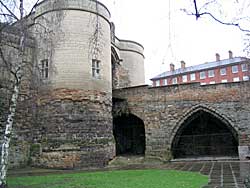 The gatehouse dates from 1252-55 but was
heavily restored in the Victorian period (A
Nicholson, 2004).
The gatehouse dates from 1252-55 but was
heavily restored in the Victorian period (A
Nicholson, 2004).With Henry III. a new era begins for Nottingham Castle. New buildings were erected on the north side of the older castle and the Liberate Rolls speak of a Great Hall with a dais, Chambers of the King and of the Queen, and in addition to the Queen's Chapel, Chapels dedicated to St. Catharine and St. William and also we know of a Postern Gate of considerable size "towards Lenton." On the whole the precincts must have been of great size and in addition to the old area probably took in what is now the Castle Green and Standard Hill, right away to the corner of Postern Street and Park Row. The west side was defended by a dry moat, a considerable section of which still remains in the castle grounds and by a wall, of which all that remains is the angle turret on the right hand side of the carriage way from the entrance to the grounds to the museum, which must have been built about 1250 and which is the earliest known example of building with Bulwell stone. To this period belongs the bridge which still spans the moat and which must be pretty early in the 13th century. It is all that remains of the main entrance to the castle of Henry III.'s time. It is possible, also, though unlikely, that the excavation that forms the present castle area may have been made at this time.
With Edward III. we come to stirring times in Nottingham's history. Mortimer and Queen Isabella had usurped the power of the Council of Regency and Mortimer's unpopularity had been increased by his action in withdrawing the English claims to the Scottish crown and allowing Scotland to be set up as a separate kingdom. This unpopularity terminated in Mortimer's arrest in Nottingham Castle on the night of October 19th, 1330, and subsequent execution at Tyburn, though whether the water-passage shown as "Mortimer's Hole" is the actual secret passage through which Sir William Eland conducted the adventurous Royal party, I am not prepared to say.
There is an unlikely tradition that in 1346 David, King of Scotland, after his defeat at Neville's Cross, commenced a weary imprisonment in Nottingham, but as we know him to have been in London three months after the battle, we may look upon his painful adventures as legendary.