< Previous | Contents | Next >
Market Street and Long Row
Another old landmark which disappeared in these alterations was the Union Inn, a house celebrated for the strength of the beer which it supplied. This was so exceedingly popular that in 1850 or thereabouts it was the rendezvous of an extremely curious club which met in the morning at four o'clock and one of whose standing rules provided that every man who had not finished his quart pot of strong ale before six o'clock struck should forfeit a gallon for the benefit of those present. It seems an extraordinary occupation to get up early in the morning for the express purpose of drinking this powerful compound.
On the site where the Picture House now stands stood a shop occupied by Messrs. Cooke & Foster, where, in 1838, was set up the first plate glass windows in Nottingham. Heretofore the advertising of goods by means of display in shop windows had been of a very elementary description for the glass which formed the windows was very rough and distorted, being made in small panes after the manner that we discussed when we were considering the origin of fan-lights. We are informed that Messrs. Cooke & Foster, the drapers who first attempted to use plate glass were not served with great sheets such as those with which we are familiar, but their panes were comparatively small, at any rate they possessed the merit of complete transparency and were such a success that Messrs. Shepperley & Pearce, the jewellers, whose premises were about where Messrs. Pearson the ironmongers now have their business, very quickly followed the fashion.
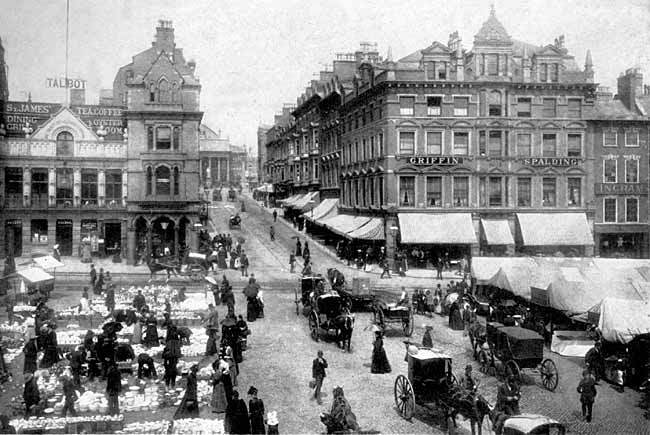
Market Street from the Market Square in the 1890s.
Market Street is a completely modern street. In ancient days one of the passages which joined Long Row with Parliament Street was not quite so constricted as the others and was used as a sort of thoroughfare. As it led directly to the Sand Field of the town, which was where the Theatre Royal and the Guardian Office are now situated, and which, from its sandy nature, produced herbage suitable for the pasturage of sheep, it was called Sheep Lane. This name was applied to it as early as 1573 and it appears to have been a continuation inside the walls of Shaw's Lane, a secondary road which has come down to us under the name of Sherwood Street. But before this time it had the strange name of Organ Lane, whose derivation I am at a loss to explain unless it derives from the old meaning of organ signifying "a communication," for undoubtedly this thoroughfare would act as a communication between Long Row and the Backside, at any rate, it was so called as early as 1395 in the reign of Richard II.
In the early part of last century this road was taken in hand and was formed into the modern thoroughfare. In 1865 on the opening day of Goose Fair, Alderman Page, the then Mayor of Nottingham, while making his preliminary perambulation of the fair paused at the foot of the new street and declared that its name was and should be known as "Theatre Street." This name, however, was regarded as very unsatisfactory and quickly changed into Market Street, notwithstanding the fact that at that time there was already a Market Street in existence in Nottingham which had to be changed as we have seen into Fletcher Gate.
At the top of Market Street is the Morley statue, which was erected in 1888 and commemorates Samuel Morley, the well-known philanthropist. He was zealous in all manner of philanthropic work and was one of the men whose life honours Nottingham. It is interesting to remember that long before any form of old age pension for industrial workers was discussed, the firm of which Mr. Morley was the head adopted a system which he had devised for his aged workpeople, allowing them 6/- per week retiring allowance, and 6/- a week in those days was an ample subsistence.
At the south-east corner of Market Street stood the Unicorn Inn which according to Mr. T. C. Hine was the first house to be roofed with tiles in Nottingham, and the date of this adventure was 1501. It is only fair to add that Mr. J. J. Bird has told me that in his opinion the "Derby Arms" which stood on the site of the extensions of the piazza on the west side of Messrs. Foster & Cooper was the first house in Nottingham to be tiled.
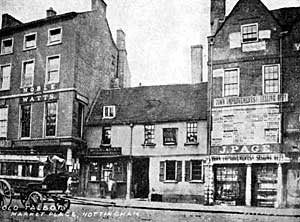
The Talbot Inn, c.1880.
The "Talbot Inn" which bears on its sign the year 1380, the year in which Piers Ploughman was published, was the Inn of the Talbots, the great family who afterwards became the Earls of Shrewsbury. They would use this Inn, I think, for their own accommodation when summoned to Councils at Nottingham, just as the Earls of Derby used the "Eagle and Child," which stood at the junction of Parliament Street and Chapel Bar. It was rebuilt about 1600 and again in modern times, and it still bears the great Talbot or hunting dog which was the family badge of the Shrewsburys.
Talbot Passage which has been swept away, but which stood near by, is interesting because in 1840 a certain Mr. Shaw tried to ride a horse down it and got killed for his pains. He appears to have been a curious half-witted character who lived in a house in the northeast corner of the modern Circus Street. He became gradually more and more ridiculous in his proceedings and one of his escapades was the purchase of a large quantity of new mown grass which he endeavoured to turn into hay by spreading it out on the public roads round about his house to the great annoyance and discomfort of his neighbours. However, he cannot always have been feeble-minded for he was founder of the well-known firm of tanners which bears his name and which still trades, I believe, in Grantham.
In 1834, in the house now occupied by Messrs. Calverts, lived Thomas Tollington, who was the last man in Nottingham who habitually wore a pigtail. He persisted in this fashion, a relic of bygone days, right down to the day of his death. In connection with pigtails it is rather interesting to remember that the fashion of wearing one's hair in this manner gave rise to the modern collar worn by sailors. The ratings of the Royal Navy wore their hair gathered into a pigtail which they mixed with a good deal of tar and pitch in order to hold it in place. This soiled the back of their jackets, to obviate which an order was issued that they should wear a washable collar of such a size that the pigtail should rub against it and so save their jackets.
A few doors further along Long Row stands the "George and Dragon," which is a modern building upon the site of an old inn which was the first building in modern Nottingham to be built of brick. Heretofore stone for the better-class houses or half-timbered work for the less expensive was the vogue in Nottingham. Bricks were well known throughout the Roman Empire and were very freely used, but somehow during the Early Middle Ages they fell into disuse as far as England in general was concerned although in certain stoneless districts such as Essex, there is a brick-building tradition extending right through the Middle Ages. This tradition did not obtain in Nottingham, and this first brick "George and Dragon" was erected in 1615.
There are very many curious and entertaining stories to be told about Long Row, but two only must serve as examples. In 1788 a certain Lieutenant Bright, who was a recruiting officer in the town retired to bed one night in his lodgings on the Long Row and soon after it was discovered that his room was on fire. Efforts were made to enter the room, but they were not successful until the fire had got so firm a hold that when Lieutenant Bright was reached life was found to be extinct. A Coroner's inquest was held and evidence was produced showing that he had introduced into the town the hitherto unknown custom of wearing braces. It was assumed that in endeavouring to take the dangerous things off he had upset his candle which had set fire to his bed-hangings and he had become so entangled in his braces that he was unable to escape and had died a martyr to progress.
Another story about Long Row concerns a certain Mr. George Burbage who lived hereabouts in 1807. He was an extraordinarily polite gentlemen and for a number of years had been the proprietor of the Journal. His affable and courteous demeanour was so well known that it became a sort of standing joke in the town and folk tried all sorts of ways to ruffle him. These jokes culminated in a bet which was laid by one gentleman that it was impossible to irritate Mr. Burbage. This bet was taken, and one dark and cold night the layer of the bet went, between one and two o'clock in the morning and hammered at Mr. Burbage's door. Mr. Burbage got up, dressed and came down stairs to see what all the noise was about and when he opened his front door his tormentor said that he had come to buy a halfpenny sheet of notepaper, Mr. Burbage led the way into his shop laboriously lighting a candle by means of his tinder box and served his annoying customer with a halfpenny sheet of notepaper, the customer paid the halfpenny and Mr. Burbage bowed him out of the shop with a smile and with the words, "I am much obliged to you, sir." Surely affableness never stood a greater strain than this.