< Previous | Contents | Next >
An itinerary of Nottingham
Thurland Street
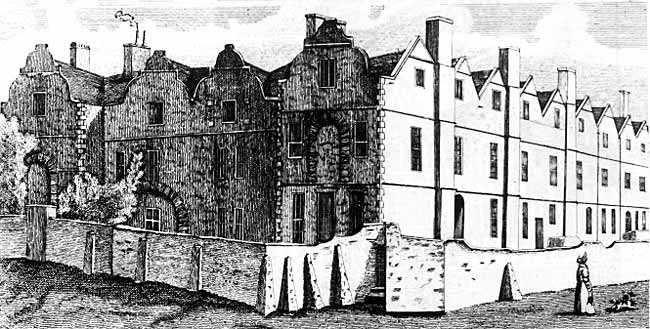
Thurland Hall shortly before demolition in the 1830s.
THURLAND Street is quite modern. It was laid out in 1845, but it is more or less upon the site of a very historic mansion which was first called Thurland Hall and then its name was changed to Clare Hall. It was called Thurland Hall from its builder, Thomas Thurland, who died in 1473 or 1474. He was an extremely wealthy merchant of the staple and a very valuable citizen, being elected as burgess and Member of Parliament four times. He was nine times Mayor of Nottingham, and his public spirit is reflected by the great gifts that he gave for the reparation of the bridge, which in those far-off times had to be kept in order by private benefactors. He was made Commissioner for Land Taxes, and it is interesting to realise that he assessed himself on one-tenth of his income, which amounted to the extraordinary sum of 74/7½d. Amongst other activities, he was a benefactor of the Trinity Guild whose altar stood in the north transept of St. Mary's Church, and eventually he was buried in this transept and the canopy of his tomb still remains. He built Thurland Hall in 1458, and a very delightful residence it must have been, for it and its grounds occupied eight and a half acres of land, the property being bounded by Parliament Street on the north, Pelham Street and Carlton Street on the south, Clumber Street on the west, and Broad Street on the east. This hall remained in the Thurland family for some time, but was eventually sold to Thomas Markham somewhere about the time of Queen Elizabeth's death.
The Markham family is interesting. It seems to have been founded by Mr. John Markham of Gotham, near Hawton, who was Standard-bearer to Queen Elizabeth's company of Gentlemen Pensioners. His son, Thomas Markham, was the man who bought Thurland Hall, and he in his turn sold it to Sir John Holles, who was son of Denzil and Eleanor Holles. He had seen much service fighting against the Armada, and had been a member of the Azores expedition, and so distinguished himself in Ireland that he won his knighthood. Thereafter, he went to Hungary and fought against the Turks and succeeded to the family estates at Houghton in 1590. The family was of great importance in 17th-century Nottingham, and when James I visited Nottingham in 1616, his eminence was emphasized by the king creating him Baron Houghton. This honour was augmented upon the occasion of James I's visit to Nottingham in 1624, when he made him the Earl of Clare.
This first Earl of Clare was married to the daughter of Sir Thomas Stanhope of Shelford, and he died in Thurland Hall in 1637 and was buried in St. Mary's Church. His son John was born in 1595, and was made Recorder of Nottingham in 1642. It was he who entertained King Charles at Thurland Hall upon the king's visit to Nottingham to raise the Standard at the commencement of the Civil War. The Earl of Clare was a Loyalist and suffered for his convictions. He died in 1665, and was buried, like his father, in St. Mary's Church.
Of his son Gilbert, the third Earl, there is little to say, but his grandson John, the fourth Earl, married in 1690 Margaret Cavendish, the co-heiress of the Duke of Newcastle, and he was created the first Duke of Newcastle of the second creation. He died in 1711, having brought into the Newcastle family the Clare name and estates.
The old hall must have been an extensive and interesting building. In the 18th century it consisted of a single wing, in the centre of which was placed a double row of ornamented pilasters. The main door was eight feet above the ground and was reached by stairs, as was common in those days. The Hall was built of brick but had a stone facade towards Pelham Street. It was crowned by curved gables, and the heavy stonework window frames gave it a rather gloomy appearance. Four royal visits were paid to it: Charles I stopped here two nights in 1612 and in 1614; in 1634, Charles I and his Queen spent five nights within its walls, and such was the popularity of the royal pair in those days, only eight years before the outbreak of hostilities, that considerable sums of money were spent in tidying up the town, cleaning and smoothingthe roads, rough casting house fronts and so forth, in order that their majesties might be edified by a neat town. Only eight years later, in 1642, Charles was again here, but his reception, as we all know, was very different from that which he obtained on his former visit.
It was just after this that a rather curious character, Robert Loveday, was employed in Thurland Hall, probably as a footman or upper servant. He had considerable literary pretensions, and published several volumes of poems, including Love's Masterpiece, which drew to its author considerable attention.
The house seems to have been abandoned by its noble owner soon after this, and in Deering's time the Tradesmen's Assembly was held in its court-room, which was seventy feet long by twenty feet wide, on the third Thursday in each month, and in 1816, at a meeting held within its walls, it was decided to establish the library which afterwards became the Bromley House Library. Eventually, the old house was pulled down in 1831, and it all disappeared. However, a few fragments still remained underground, and these were discovered in the course of some building operations in Cobden Chambers by the late Mr. Harry Gill. They only consisted of foundations which, I believe, Mr. Gill carefully measured and drew, but unfortunately I do not know where these drawings are now preserved.
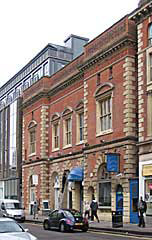
The Corn Exchange, Thurland Street (A Nicholson, 2004).
On part of the site of Thurland Hall the Corn Exchange was built in 1850, and thirteen years later, in 1863, within the walls of this Corn Exchange, the Nottingham Chamber of Commerce was established.
Number eight is the building in which, in 1853, the Artisans' Library was established, which afterwards developed into the Free Public Library which was opened on April 13th, 1868, by Alderman Barber, the then Mayor of Nottingham.