< Previous | Contents | Next >
Carlton Street, George Street and Lincoln Street
CARLTON STREET.
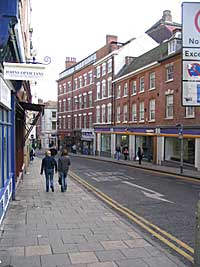
Carlton Street (A Nicholson, 2004).
Carlton Street, a wide open space nowadays, is a relic of very ancient times. It only obtained its present name in 1802, and before that it had been called Swine Green, a name which clung to it even after it had been officially designated Carlton Street. We can trace this name of Swine Green back as far as 1408, and it calls up visions of an agricultural Nottingham which has now disappeared. In the Middle Ages, everybody kept swine, but they were a public nuisance. One comes across all sorts of strange regulations concerning them in old records, but even allowing for these regulations, it must have been very unpleasant to have pig-styes here, there and everywhere throughout the town. A swineherd was appointed for Nottingham, and it was his duty each morning to collect the swine of the town and drive them out to their feeding ground at the Coppice and elsewhere, and to bring them back again in the evening, and it was on Swine Green that the pigs were collected each morning and a certain number of them were herded there for the night. It appears to have been an extensive area, stretching down as far as Parliament Street, and at its lower end in later times a pottery sprung up. Somewhere on it, as we have seen when considering High Cross Street was situated the mysterious Headless Cross, and it was in this open space that was first established the great fair of St. Matthew, which has come down to our day as Goose Fair.
The George Hotel is called after George de Ligne Gregory, who was the representative of the Gregory family in his day. The Gregory's as we have seen, built their great house facing Swine Green at the upper end of Gridlesmith Gate in 1674. There were two families of Gregory in Nottingham in the 17th century which were unconnected with each other. This family was established by John Gregory, who was Mayor in 1571 and again in 1586. His son, William, represented the town in Parliament and gave the tenements called the White Rents to the town for the benefit of the poor. The family has always been very intimately associated with the public life of the town until almost modern times, and a portion of their old house still remains behind the modern premises occupied as a banking house and as Messrs. Bell's book shop.
GEORGE STREET.
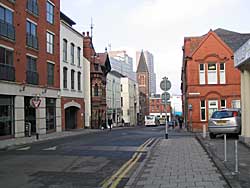
George Street (A Nicholson, 2004).
George Street is so called in honour of George de Lign Gregory, who sold the land upon which George Street was formed for building, about 1810. For a long time, the district had been known as Gregory's Paddock, but this was considered by no means a sufficiently dignified name, and so the modern one was adopted.
As the street is so modern, there is little of interest to say about it. Upon its eastern side stood, from 1820 to 1925, St. Paul's Church, which was built from the designs of a London architect, a certain Mr. Wilkins. Its classic exterior was somewhat impressive with its great portico supported by Corinthian pillars. Although in its early days it did good work and made its mark upon the ecclesiastical life and local history of the town, it gradually became redundant as the district ceased to be residential, and its congregation removed elsewhere, and so eventually it was pulled down and its site has been utilised for business premises.
During its demolition, very extensive relics of a mediaeval kiln were found underneath it, which were probably associated with the potteries which were known to have worked in this neighbourhood up to about the 15th century.
Almost opposite to the site upon which St. Paul's Church stood, remains an ecclesiastical-looking building now used for business purposes. This is the old centre of Roman Catholic activities in the town. As we have seen already, for many years the Roman Catholics met in King's Place, but about 1827 their activities were very much increased and many new converts flocked to their place of worship. This humble sanctuary in King's Place was found to be quite inadequate for their needs, and so a site was purchased in Gregory's Paddock and a church was erected and opened in 1828. It remained their principal centre until St. Barnabas Cathedral on Derby Road was ready tor their occupation, and when they removed to their new Cathedral, they disposed of the old building in George Street, and upon dismantling it sold the organ to St. Nicholas Church. The Baptist Chapel which stands close to this disused church, was built at the cost of £6,000 in 1815. This body of worshippers was originally formed in Carey's Chapel in Park Street.
The only interesting event which has occurred in George Street appears to have been in 1832. In that year the town celebrated with processions, banners, and all manner of festivities the passing of the Reform Bill. The school children of the town took part in the procession, and at the conclusion of their itinerary they were marched into George Street, the ends of which were barricaded off, and there the children were regaled with tea.
LINCOLN STREET.
Lincoln Street, with its tributaries Clinton Street and Houghton Street, reflect the titles of the Newcastle family, and appear to have been formed about 1812 to give access to the back land of Clumber Street, which, at that period, was sold by the Duke of Newcastle for building purposes. Only one interesting person seems to have lived in this neighbourhood, and his interest is rather more gruesome than important, and we have already met him when considering the General Cemetery, for it was in Lincoln Street that in 1838 lived John Wheatley, the eccentric who, so far from fearing death and all funeral panoplies, purchased for himself a site in the General Cemetery where he caused so much scandal by erecting a summer house by the side ol his open grave. In his house in Lincoln Street, he kept his coffin which, he used as a cupboard in which to store his supply of beer and wine.