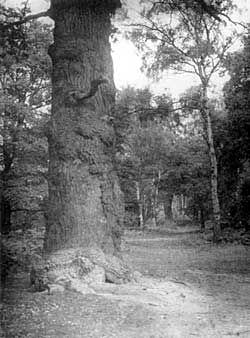
A veteran of Sherwood Forest, Edwinstowe, Notts.
Ralph, son of Reynold of Edwinstowe had taken an oak (value tenpence) and was fined two shillings.
Richard of Blidworth for some rafters worth tenpence, fined two shillings.
Two who had found and carried away honey worth sixpence, fined one shilling.
The verderers of Mansfield, Linby, Bulwell, Calverton and Edwinstowe were fined sums varying from five shillings to seventy-three shillings and ninepence, for the non-production of the rolls of attachment.
In connection with the gradual amelioration in the severity of the laws of game trepass, it should not be overlooked that royal severity was almost, if not quite, equalled by the harsh game laws of the 18th and early 19th century operated by the landowners. It is true, of course, that they had not the power of legal mutilation; but they found an equally potent substitute by installing man traps and spring-guns on their estates.
In addition to the attachment courts and the eyre, there was the swanimote, which was a meeting of the foresters to make arrangements regarding pasture and to receive rents : and the special inquisition, held when a deer was found dead or wounded (which involved the four nearest townships in the inquiry), or for forest trespasses.
Further, there were often questions of nuisances, a technical term, which had to be considered and dealt with, These involved such offences as the stopping of a highway (by building a house athwart it); raising a hedge, digging a ditch; diverting water from a mill or dam; overhanging trees; smoking chimneys; stopping a gutter; the smells of butchery; the flooding of land; ancient lights.
In addition to the penalties involved for the poacher by the normal court procedure, he suffered from deprivation of religious privileges, if by chance he committed his trespass on land held by the Church. In 1253 an announcement was made by the bishops: "We, arrayed with our pontificals, with candles burning in our hands, solemnly declare the sentence of cursing in all trespassers and breakers of the liberties of the church." After the invocation of the authority of the Holy Trinity, they added that of the Blessed Virgin, the Apostles Peter and Paul, all the Apostles, all Martyrs, Lord Edward the Confessor, St. Thomas, Archbishop of Canterbury and Martyr, all the Confessors, Virgins and all the Saints of God: and then proceeded: "we accurse and from the privileges of Holy Church we sequester and depart all those that from henceforth wittingly or maliciously deprive or despoil the Holy Church of their right . . . ." Leaving out the question of deer, it seems a lot of bother over poaching a hare.
It is sometimes said that among those who committed forest offences, there were few examples of monks offending, while quite a number of the parochial clergy were cited. This may well be accounted for by the fact that the abbeys and priories had many privileges granted to them, and therefore had not the same incentive to infringe the forest laws.
The plan upon which the regard was made was based on a series of questions. The following, taken from the regard in the second year of the first coronation of Henry III illustrate these queries: —
Of Assarts (conversion of forest to arable)—acreage, who made them, who holds them, with what corn they were sown.
Of Purprestures (illegal enclosure or encroachment), old and new—in lands, heaths, morysses, pooles, marlepitts or a dike; or of arable.
To see all waste and woods.
To number every stub of oak or beech.
Whether the Hays are properly kept.
What owries of Goshawks, Marlyans and Falcons.
In whose fee and for what rent were forges, smithys and mines.
Whose is the honey.
Who have bowes arrows, arrow-blasts, braches, greyhounds or any other
engine to hurt the Lord King of his deer.
By the assize of the forest, a man going through the forest had to bear his bow without a string and "if by the King's way he lead any dogs, he lead them coupled and his greyhound knitted to his lease." Nor could any tanner, currier, or whitster of leather dwell in the king's forest out of a borough town.
The forest had its own measures, and in about 31, Edward III they were defined as follows. "It is ordained that three corns of barley dry and round, set on length make one inch, and eighteen inches make one foot after the assize of the forest, and that twenty-five such feet make a perch, and forty perches in length and four in breadth make an acre, and one rood containeth one perch of twenty-four feet in breadth and forty such perches in length, and forty such perches in length and four such roods make an acre." The celebrated 'Forest Measure' in Edwinstowe church is actually nothing of the kind, but part of a stone with normal dog-tooth ornamentation.
There were exceptions to these standards, particularly where the perch had been defined by charter; as for example in Swine Hawe and Hardwick Holewell and the assarts in Linby Hay (perch of 24 feet); the thirty acres of waste between Radwell Sick and Annesley Hay; 24 acres of wood and 40 acres of wood in Bulwell Rise (perch of 21 feet).
SHERWOOD FOREST.
It would perhaps be true to say that most people are conscious of only two forests in England, Sherwood Forest and the New Forest; and this awareness probably springs from fictional reasons, dating back to childhood's stories of Robin Hood, and the Children of the New Forest. Yet in the records of the 13th century, when a great storm swept the country and great damage was done to the trees, there were forty-two forests listed for enquiry, and a further twenty-six later, making a total (still incomplete) of sixty-eight. Thus Sherwood Forest was only part of the great forest system. It is a matter of congratulation that in its case a ready-made forest was available, so that there was no question of depopulation and destruction such as took place in the formation of the New Forest, where William the Conqueror is said to have laid waste more than sixty parishes and compelled the inhabitants to emigrate to other places to satisfy his ardour for hunting.
Sherwood Forest occupied the central and western part of Nottinghamshire, covering, in the Middle Ages, more than a quarter of the area of the county as against the mere twentieth of forest existing today. It stretched from Nottingham in the south, to the boundaries of Worksop on the north; from Derbyshire on the west to Wellow on the east.
Originally the forest area was divided into two sections, but later (like all Gaul) was divided into three parts. One part lay between the Rivers Leen and Ooverbeck, another was called the High Forest and the third Rumwood.
The earliest perambulation, quoted in White's Dukery Records and dated 1218, was found to be an incorrect record, since the regarders had managed to omit a tract west of Newstead, and also a larger tract of land west of the Doverbeck, the later eastern boundary. Whether this was a true error, or an attempt at disafforestation is a matter of conjecture; but there was a very similar occurrence in the time of Edward I, when in 1300 he found that Rumwood, Carburton, Owsland, Clumber, Scofton, Rayton, half Budby, Thoresby, Skegby, Sutton-in-Ashfield, the hamlets adjoining Bulwell, Welley Hay and Littlehagh had all been omitted, and ordered them to be placed within the forest, as they were parts of the old demesnes of the crown. The excuse that the regarders found it difficult to follow the old and true boundaries, may or may not have been correct, but if they hoped to gain advantage of the king, they were certainly in error. Right up to the time of 30 Henry VIII the old boundaries were maintained, but then the forest began to be broken up.
Enclosures were taking place rapidly in the 17th century. From 1683 onwards, Thoresby park (1,270 acres) and Clumber park (3,000 acres) were both cut out. Then in 1789 the forests of Arnold, Basford, Sutton, Kirkby, Lenton and Radford (8,248 acres) were enclosed, and by 1799 Birkland and Bilhaugh (1,487 acres) alone remained to the crown. These were soon afterwards conveyed to the Duke of Portland in exchange for the advowson of St. Mary le Bone, London; later still Birkland was conveyed to the Manvers estate in exchange for the Manors of Holbeck and Bonbusk.