< Previous | Contents | Next >
The Castle.
PART I.- ITS HISTORY.
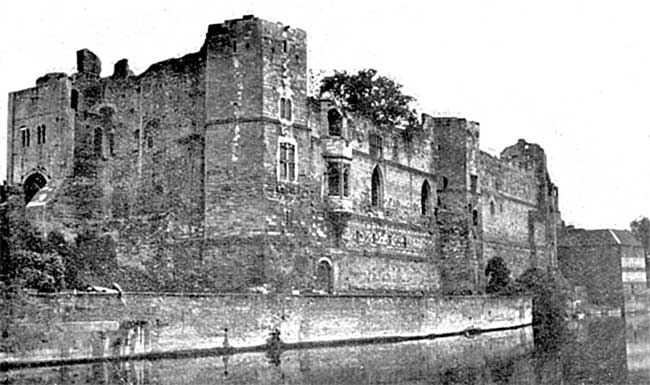
Newark Castle.
Newark before the Conquest belonged to that Countess Godiva of Coventry, whose act of chivalry has been made immortal by Tennyson. She gave it to the church of Stow in 1055, and by an exchange of lands it passed into the possession of the Bishops of Lincoln. One of these, Bishop Alexander (1123-1147), who built also the castle of Sleaford, began to build this of Newark about the year 1130, obtaining a licence from King Henry I. to divert the Fosse Way (which here probably skirted the river too closely to leave space for his Castle), to build a bridge over the Trent near the Castle, and to construct a fish pond on part of the diverted Fosse. This fish pond was probably a widening of the moat to the south or south-east of the Castle. Stodman Street, opposite, was formerly Stodmere Street.
Bishop Alexander did not long enjoy the possession of his fine new Castle, "a magnificent Castle of very ornate construction," as Henry of Huntingdon, a contemporary writer, describes it, for King Stephen demanded its surrender in 1139 and took possession of it in person.
King John was at the Castle in 1205, in 1211, and in 1215. In October of the following year, after ravaging the property of the Abbey of Crowland, he lost his baggage and treasure (including the Crown of England itself, the actual circlet of Edward the Confessor) in fording the Well Stream near Long Sutton, and coming north, was taken ill at Swineshead Abbey, but rode on horseback to Sleaford, whence he had to be borne in a litter to this Castle of Newark, which he reached on October 16th, and where he died three days later—on St. Luke's day, 1216.
In the following year the Castle saw stirring events. It was the rendezvous of the force mustered by the Regent of the boy king (Henry III.) to proceed to the relief of Lincoln Castle, where the loyal old lady castellan, Nicole de la Have, was beseiged by Gilbert de Gaunt and an army of Frenchmen. The Regent came to Newark in person, and with him the Papal Legate and the Bishop of Winchester, four great earls (Chester, Salisbury, Ferrers, and Albemarle), many barons, 400 knights, and 250 cross-bowmen (answering to our cavalry and field artillery respectively), besides a host of spearmen and archers. These tarried three days at Newark to refresh themselves, then "on the sixth day of Whitsuntide," as the chronicler relates, after the celebration of the Holy Sacrament, and after the Papal Legate, putting on his white robes, had given them absolution and blessing, and cursed the King's enemies, they took horse and clattered off down Northgate on their way to Lincoln, where they defeated the forces of the Dauphin and compelled him to evacuate the realm, thus solving the first of the great difficulties which King John's legacy of anarchy had created, and establishing the ten-year-old boy on the throne which he held for over half-a-century.
But Newark was not yet free from trouble, for suddenly Robert de Gaugy, who had been given the custody of the Castle by King John, refused to hand it over to its rightful owner, the Bishop of Lincoln, even when ordered to do so by the King's mandate, one of his excuses appearing to be a claim for compensation for money expended by him in stores, &c., which he had by him in the Castle. Anyhow, his record was bad, for he had been one of John's worst barons, and had plundered the surrounding country, and his attitude being very truculent and defiant, the Earl Marshal, with the boy-king in person, marched to Newark to compel its surrender. Gaugy defied them, and so, after a sortie of the garrison had been driven in, the Eoyal forces prepared to besiege it, sending to Lincoln for two hundred pick-axes, and employing siege artillery in the shape of great stone-throwing engines called mangonels. After an eight days' assault, in which small impression was made on the huge walls, a compromise was arrived at, whereby Gaugy surrendered the Castle, and the Bishop agreed to pay him £100 for the stores it contained (July, 1218). Robert de Gaugy marched out with his freebooters, and a few months later, excommunicated for his treason, he died at Dunstable, "smitten with the infernal fire," as the old chronicler saith.
For the next three hundred years the Castle remained in the hands of the Bishops of Lincoln. Edward I., in the flowery period of English chivalry, was here on many occasions, sometimes on his way to the tournament at Blyth, more often passing through on the business of his Scottish wars. In 1487, Henry VII. was here on his way to the Battle of Stoke close by, which, as we have said, ended the Wars of the Roses, and established the Tudor dynasty on the throne.
In 1547, the long connection of the Bishops of Lincoln with the Castle and town came to an end, for in that year Bishop Henry Holbeach surrendered to the King, in exchange for other lands, the Castle of Newark, together with the Manor and its jurisdiction over half the Wapentake, and the adjacent manors of Farndon, Balderton, Coddington, Winthorpe, and Moorland.
From this time, down to its sale to the Corporation in 1888, the Castle belonged to the Crown, though after the Civil War it was but a ruin, and until that period was mostly leased to private individuals as a residence. Thus in 1560 Sir Francis Leeke, of Sutton Scarsdale, had a lease of it for a period of twenty-one years, on the expiration of which it was granted (14th Feb., 1581) to the Earl of Eutland, the Countess his wife, and their daughter, Elizabeth (Baroness Roos), for the term of their lives. On 11th July, 1620, all these persons being dead, it was granted to Sir Thomas Howard, and his sons Thomas and Charles, on a lease for 90 years from the death of William, Lord Burleigh, second Earl of Exeter, who had married the above Elizabeth. The course of this last lease was interrupted, and rendered null, by the outbreak of the Civil War, when the Castle served its last and most glorious duty, and made history most brilliantly, being garrisoned for the King and right gallantly defended, as has already been related.
After the evacuation of the town by its garrison on the King's command, levies of labourers from the surrounding villages were summoned by order of the Parliamentarians to demolish the fortifications. The dismantling of the Castle began on the 11th of May, 1646, and it seems to have been reduced to much the same proportions and conditions in which we see it to-day, though some portions of the N.E. walling lying towards the present entrance of the gardens were not entirely removed until 1773, when their materials were used for raising the level of Northgate.
The present grounds of the Castle were, until 1883, occupied by some public baths, a bowling green, a quantity of sheds and warehouses, and the Cattle Market. In 1881 the late Sir William Gilstrap bought the Cattle Market, and on part of it erected and partially endowed the "Gilstrap Free Library." On the formation of the present Cattle Market, near the Midland Station, the site of the old one was purchased from the Library Trustees (part of whose endowment it formed) by a fund raised by public subscription, of which Lady Ossington gave £1,200, and the late Mr. Henry Branston £500. The Corporation then bought the freehold of the Castle itself, with the bowling green, &c., from the Commissioners of Woods and Forests (who held it for the Crown) for £500. The whole was cleared of encumbering buildings; the tops of the Castle walls were secured against the weather by a layer of concrete, and the structure made secure in places where it was unsafe or threatened further decay. The grounds were laid out as now seen, and opened to the public on the 24th of May, 1889, among the guests on the occasion being the Bishop of Lincoln, the direct official successor of the builder of the Castle 750 years earlier.